The essentials in 30 seconds
Why do some children struggle with reading, writing or maths despite their best efforts? To understand this, we first need to look at what the brain draws on when it learns. This article looks at the cognitive functions involved in learning, what happens when a learning disorder is present, and the real but limited role that neurofeedback can play.
Learning: what the brain does
Learning means making lasting changes to networks of neurons: each time we practise, the connections involved get stronger, until a task becomes almost automatic. This is brain plasticity. The neuroscientist Stanislas Dehaene, professor at the Collège de France, sums up the conditions for effective learning as four pillars (Apprendre!, Odile Jacob, 2018; published in English as How We Learn).
The cognitive functions that underpin learning
Reading, writing and maths rely on specific skills (sounds, letters, numbers, movements), but also on cross-cutting functions that are constantly called upon in class. The researcher Adele Diamond describes three core executive functions: inhibitory control, working memory and cognitive flexibility, on which planning and reasoning are built.
Attention
Focusing on the instructions, filtering out distractions, keeping up the effort until the end of the exercise.
Working memory
Keeping information in mind long enough to use it: a dictated sentence, a number carried over in a sum, a three-step instruction.
Inhibition and flexibility
Holding back an impulsive response, changing strategy when the first one does not work, planning your work.
Automatisation
Once a skill is automatic, attention is freed up for understanding. Until then, every word or calculation uses up energy.
These functions are closely linked. For example, a meta-analysis showed that children with learning difficulties often have working memory weaknesses (Peng and Fuchs, 2016). Stress and anxiety about school also use up some of the available attentional resources.
When a learning disorder is present
A specific learning disorder (known in France as a “dys” disorder) is a long-lasting neurodevelopmental condition that affects a particular skill despite appropriate teaching. According to the French National Authority for Health (HAS, 2018), it is diagnosed by a doctor, working with therapists. It often places extra demands on cross-cutting functions, which is why these children tire easily. It frequently occurs alongside ADHD: in fact, when ADHD is being assessed, the HAS recommends checking for an associated learning disorder.
| Disorder | Skill affected | Cross-cutting functions under heavy demand | Therapy |
|---|---|---|---|
| Dyslexia, dysorthographia (spelling disorder) | Written word recognition, spelling | Attention, verbal working memory | Speech and language therapy |
| Dyscalculia | Number sense, calculation | Working memory, planning | Speech and language therapy |
| Dyspraxia (DCD) | Planning and coordinating movements, handwriting | Visuospatial attention, dual-tasking | Psychomotor therapy, occupational therapy |
| Developmental language disorder (dysphasia) | Understanding or expressing spoken language | Verbal working memory, auditory attention | Speech and language therapy |
The example of reading: why reading is so tiring for a dyslexic child
Reading means connecting the visual system to the spoken-language areas of the brain. As learning progresses, a small region of the left occipito-temporal cortex specialises in recognising written words: researchers call it the visual word form area (Dehaene and Cohen, 2011). At first, decoding requires a great deal of attention; as reading becomes automatic, this effort decreases and attention is freed up for comprehension. In dyslexic children, this automatisation is slower: reading remains effortful, and fatigue sets in more quickly.
Habits that help learning
Research in cognitive psychology has assessed how useful different learning techniques are, and two of them stand out: self-testing and spacing out revision (Dunlosky et al., 2013). Sleep also plays an active role in the consolidation of memories (Diekelmann and Born, 2010). For children with specific learning difficulties, these principles are adapted with the help of the speech and language therapist and the teacher.
Sleep is doubly important for children who also have ADHD: read our article sleep and ADHD in children.
So where does neurofeedback fit in?
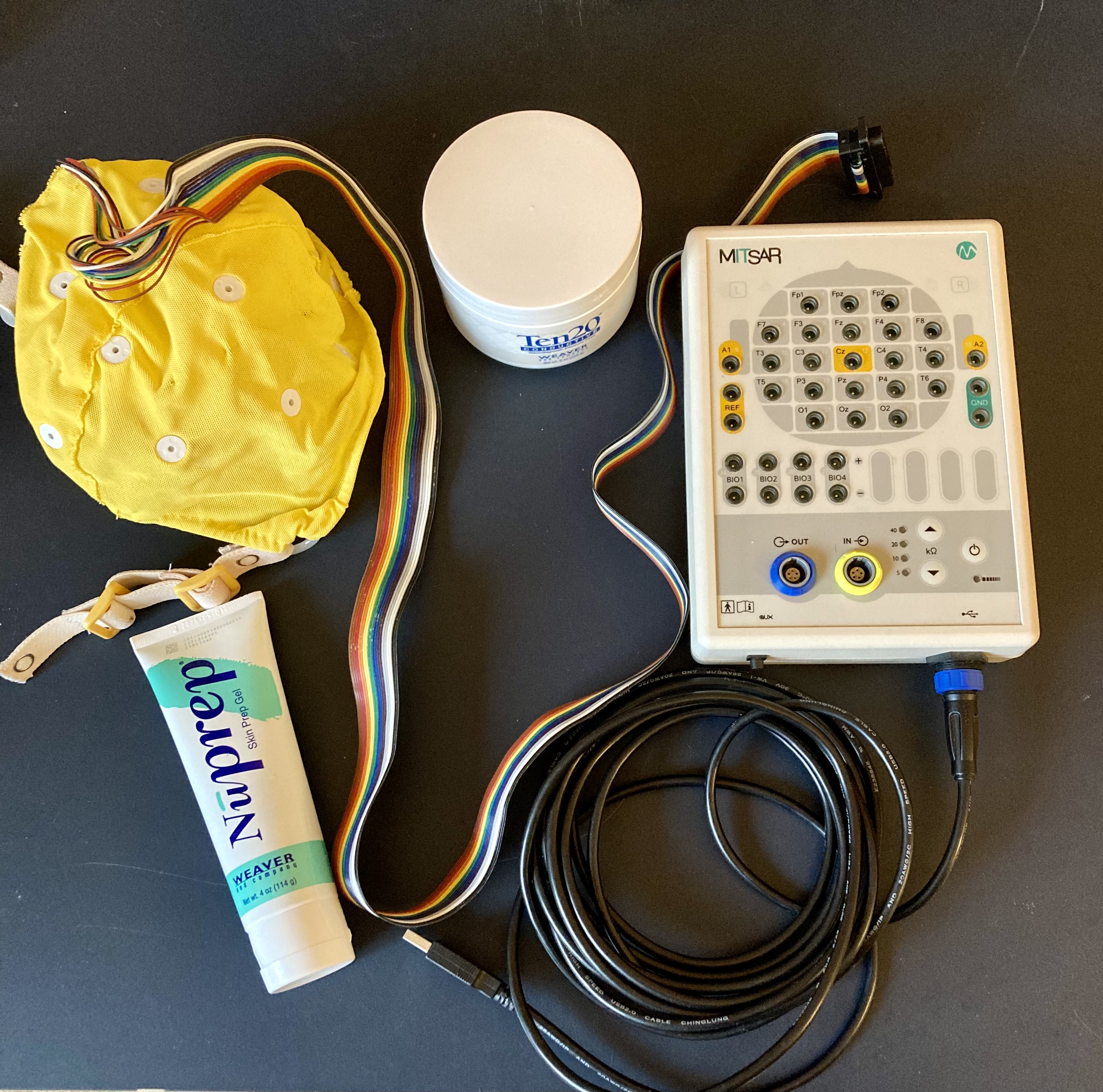
Neurofeedback is a form of training: the brain’s electrical activity is measured in real time, and the child receives feedback (an image, a sound) when they get closer to the target state. It draws on the pillars of learning: attention, engagement, immediate feedback, repetition. It does not work on reading or maths themselves, but targets cross-cutting functions: sustained attention, arousal level, self-regulation. Biofeedback (breathing, cardiac coherence) helps children approach stressful school situations more calmly.
What the research suggestssmall studies
- In children whose EEG showed an excess of slow waves, one team reported cognitive gains and EEG maturation after training (Fernández et al., 2003)
- In 19 dyslexic children, progress in spelling, not in reading (Breteler et al., 2010)
What is still missingstate of the evidence
- A review of 12 studies finds no demonstrated benefit of neurofeedback alone on reading (López-Zamora et al., 2026)
- For ADHD, which often occurs alongside learning disorders, the HAS considers that there is “not a sufficient level of evidence” to offer it (2024)
The most frequently cited two-year follow-up study is analysed in our article neurofeedback and specific learning difficulties: what does the two-year follow-up study show? For practical arrangements with the speech and language therapist and the school, see supporting a child with specific learning difficulties: speech and language therapy, school and neurofeedback.
The qEEG assessment: a starting point, not a diagnosis
The quantitative EEG assessment compares the child’s brain activity with a normative database for their age. It helps to choose training targets and to track changes from one assessment to the next. It cannot diagnose a specific learning difficulty: diagnosis remains a medical matter. Find out how the qEEG assessment works.
Frequently asked questions
Does a child with specific learning difficulties necessarily have an attention problem?
Not necessarily. But compensating for a specific learning difficulty takes constant effort, which wears out attention more quickly. If inattention is marked, even outside written tasks, talk to the doctor: ADHD is often present as well.
Does neurofeedback improve working memory?
Some studies have explored this, but the evidence remains limited. We do not promise results: the aim is to train the attention and self-regulation that make learning less effortful, alongside therapy.
How many sessions should I expect?
The number of sessions is set after the qEEG assessment and adjusted at the mid-point assessment. On average, allow around thirty one-hour sessions, once or twice a week.
Sources
- Dehaene S. (2012). Les grands principes de l’apprentissage. Symposium “Sciences cognitives et éducation”, Collège de France
- Diamond A. (2013). Executive functions. Annual Review of Psychology, 64, 135-168
- Peng P., Fuchs D. (2016). A meta-analysis of working memory deficits in children with learning difficulties. Journal of Learning Disabilities, 49(1)
- Dehaene S., Cohen L. (2011). The unique role of the visual word form area in reading. Trends in Cognitive Sciences, 15(6), 254-262
- Dunlosky J. et al. (2013). Improving students’ learning with effective learning techniques. Psychological Science in the Public Interest, 14(1), 4-58
- Diekelmann S., Born J. (2010). The memory function of sleep. Nature Reviews Neuroscience, 11(2), 114-126
- HAS (2018). Troubles dys: comment mieux organiser le parcours de santé? Guide parcours de santé [Specific learning difficulties (“dys” disorders): how can the care pathway be better organised? Care pathway guide]
- HAS (2024). Trouble du neurodéveloppement / TDAH: diagnostic et interventions thérapeutiques auprès des enfants et adolescents [Neurodevelopmental disorder / ADHD: diagnosis and therapeutic interventions for children and adolescents]. Recommendations
- Fernández T. et al. (2003). EEG and behavioral changes following neurofeedback treatment in learning disabled children. Clinical Electroencephalography, 34(3), 145-152
- Breteler M.H.M. et al. (2010). Improvements in spelling after QEEG-based neurofeedback in dyslexia. Applied Psychophysiology and Biofeedback, 35(1), 5-11
- López-Zamora M. et al. (2026). Efficacy of neurofeedback in the treatment of dyslexia: a systematic review. Annals of Dyslexia, 76(1), 137-155