Biofeedback sessions: learning to regulate your body and your stress
Breathing, pulse, skin, muscles and temperature: five body signals, often used alongside neurofeedback, to help you learn to self-regulate. From age 5, in Brétigny-sur-Orge, near Paris.
The essentials in 30 seconds
Five body signals, liveBreathing (respiration belt), pulse, skin, muscles and hand temperature are displayed on screen.
Learning to self-regulateGuided by the screen, you learn to slow down, relax and recover, and then to do it on your own.
Body and brain togetherOften combined with neurofeedback during the one-hour session, to calm both body and mind.
A complementary approachIt does not replace medical advice, treatment or remedial therapy.
Does any of this sound familiar?
A child who can’t sit still
Restless or tense, they hold their breath over their homework.
A teenager facing exams
Racing heart, held breath, mind going blank.
An adult under strain
Hunched-up shoulders, thoughts going round in circles, fatigue that won’t go away.
Restless nights
The body stays on alert at bedtime: it’s hard to switch off.
Tension-related pain
Headaches, a stiff neck, a clenched jaw, cold hands.
Athlete or business leader
Recovering better, staying calm under pressure. See our services for businesses.
In each case, the body sends signals we no longer notice. Biofeedback makes them visible.
How does biofeedback work?
Biofeedback (physiological feedback) makes a body signal visible in real time so that you can learn to change it. When the signal moves in the right direction, a curve becomes smoother or a sound confirms it.
These signals depend on the autonomic nervous system: its sympathetic branch speeds things up in response to stress, while its parasympathetic branch puts on the brakes and promotes recovery.
Biofeedback or neurofeedback? Biofeedback works with body signals; neurofeedback works with the brain’s electrical activity. At the centre, the two are often combined: see below.
The BioGraph Infiniti software (Thought Technology) records the five signals described below.
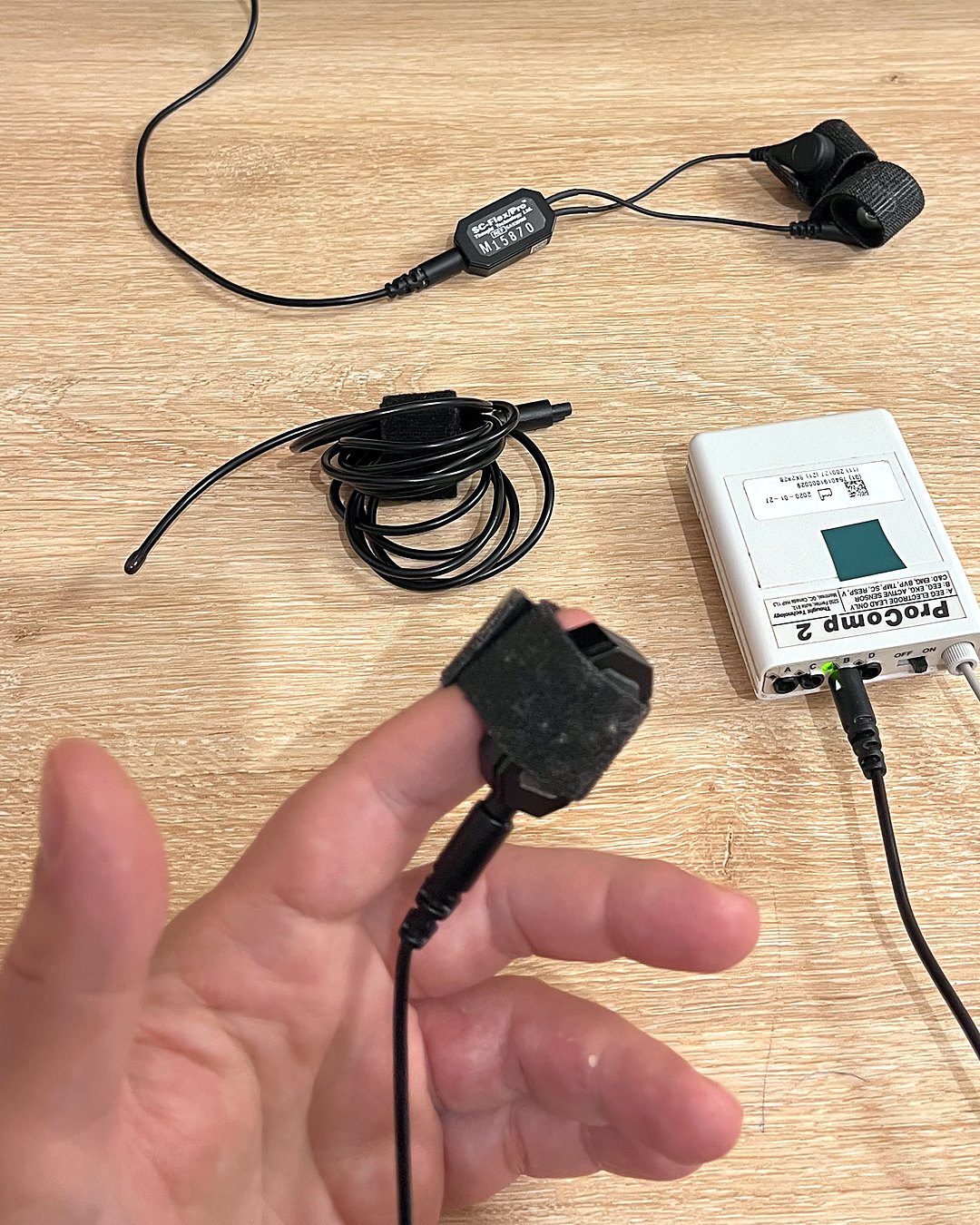
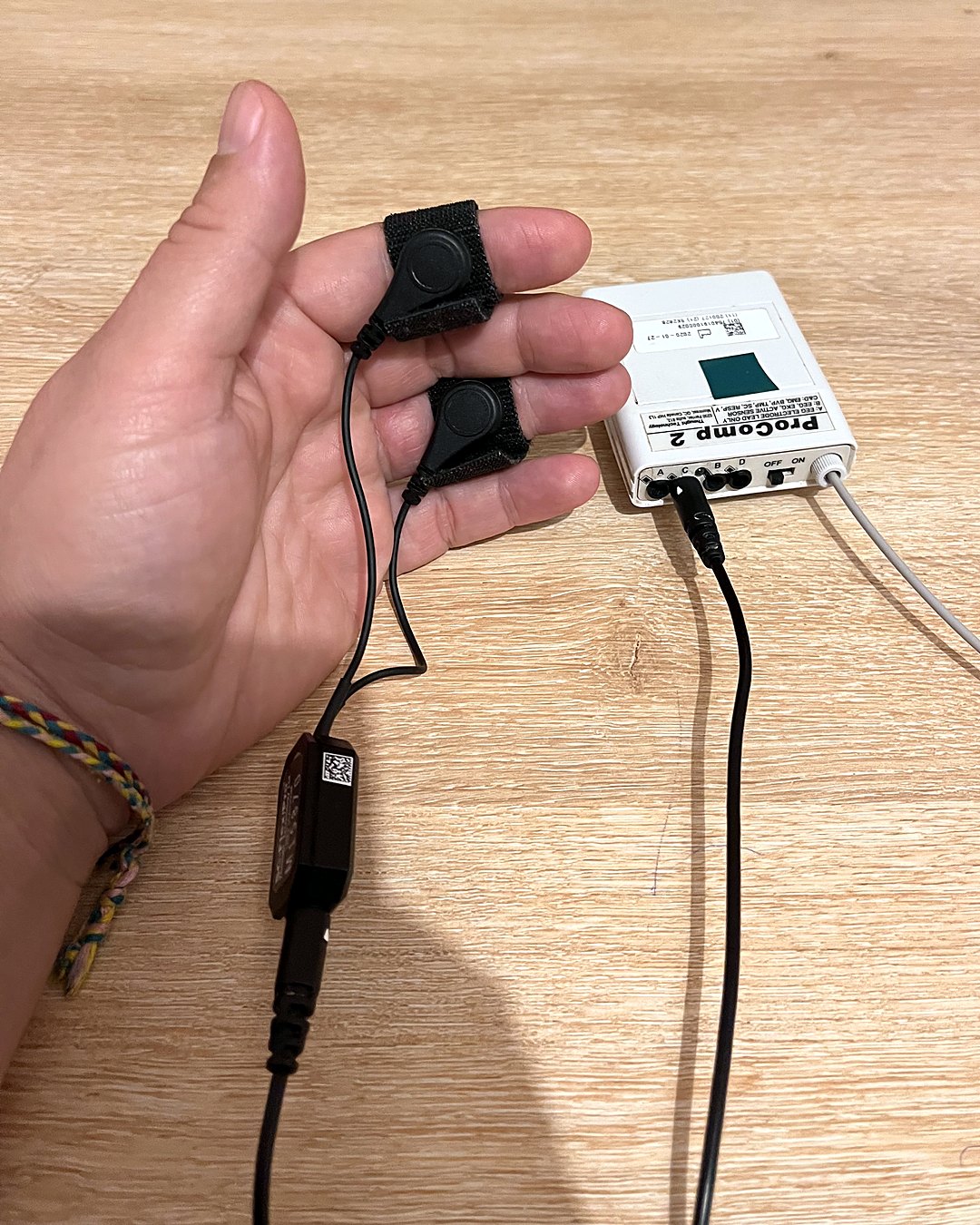
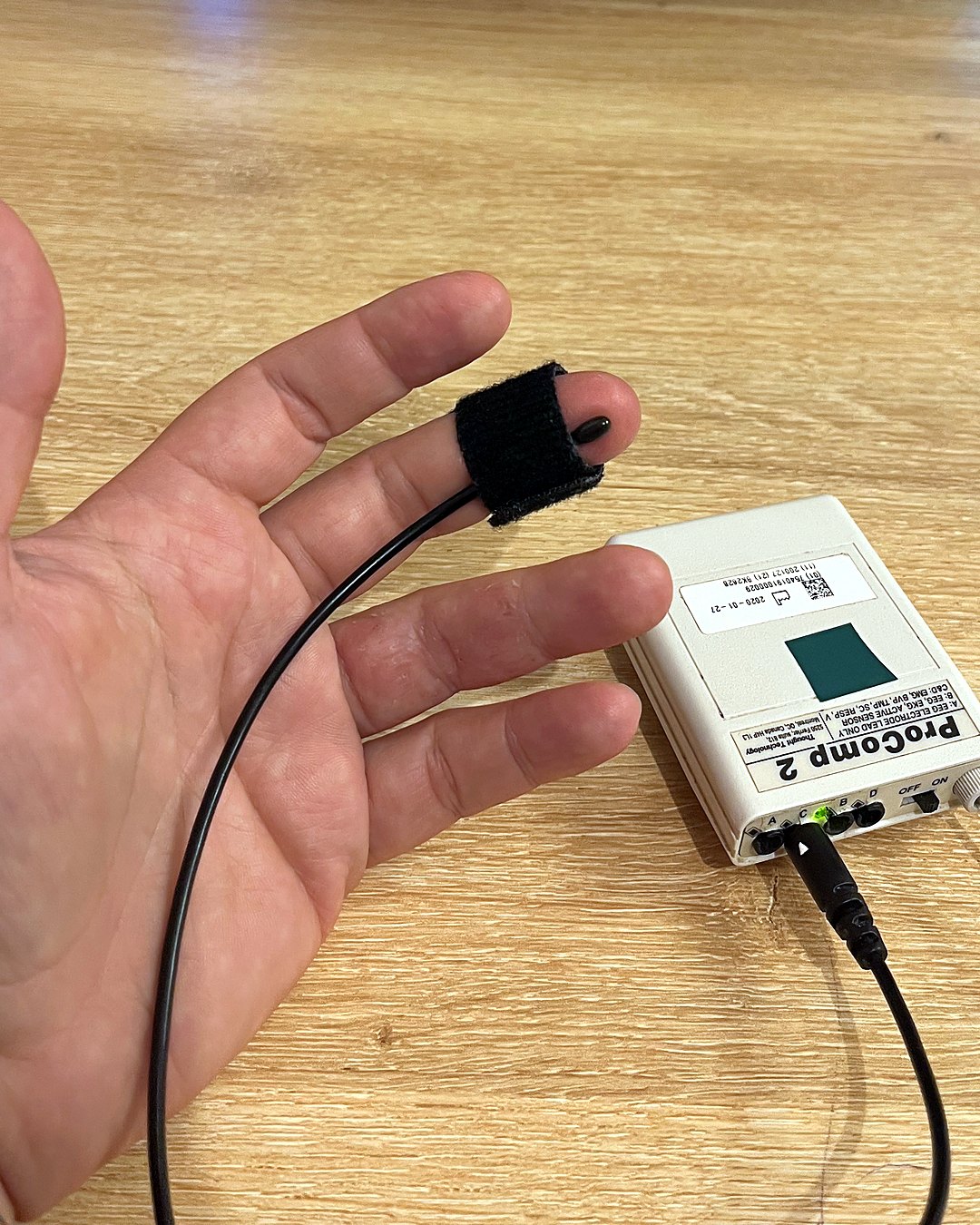
The pulse sensor (BVP), on the fingertip.The electrodermal activity electrodes, on two fingers.The temperature probe, on the fingertip.
Breathing: the respiration belt
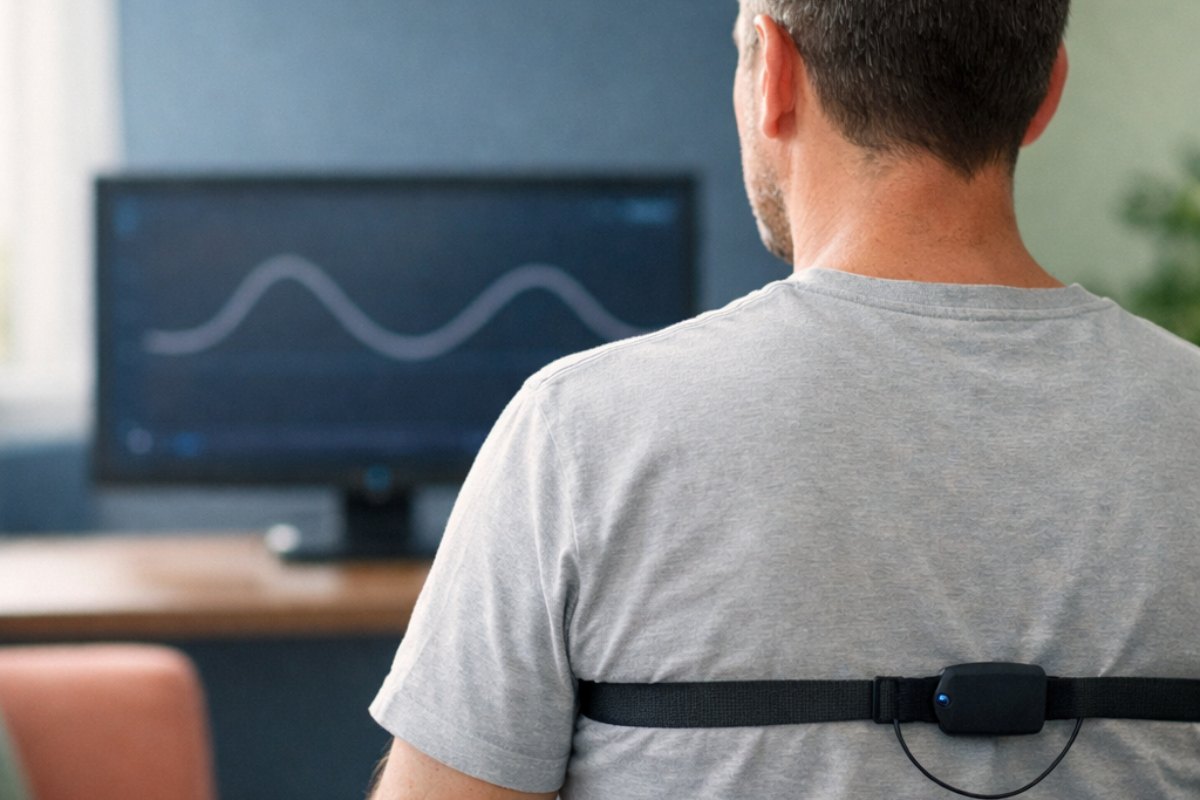
What is measured. A thin elastic belt, worn over your clothes around the chest or belly as needed, tracks each in-breath (Thought Technology). The curve shows the rate, amplitude (depth of breathing), regularity, pauses and sighs. Placed on the chest or belly, and combined with observation, it helps to spot whether you tend to breathe high (chest, shoulders) or low (belly).
What it tells us about the body. Breathing is the automatic function that is easiest to control at will: a gateway to the autonomic nervous system. Under pressure, it speeds up and rises into the chest; even a little mental effort is enough to speed it up (Grassmann et al., 2016). In sessions, some people hold their breath as soon as they concentrate. According to Institut Neurosens, breathing, muscle tone and posture form a tonic-ventilatory system. This working hypothesis suggests stabilising this foundation before working on attention (Institut Neurosens, 2025).
The exercise. Observe your breathing without correcting it, then breathe more slowly and lower, from the belly, through the nose if possible, letting the out-breath lengthen, without holding your breath. Finally, keep this steady breathing while reading or doing sums. Never force it: breathing too hard can make you dizzy.
The respiration belt follows the rate and amplitude of breathing (illustration)
< 10 / minthe threshold for slow breathing: more heart rate variability, more relaxationSource: Zaccaro et al., 2018
223 studiespooled: slow breathing strengthens the “brake” on heart rateSource: Laborde et al., 2022
12 trialsrandomised, with 785 adults: lower perceived stress, a small-to-medium effectSource: Fincham et al., 2023
Shallow breathing, anxietyHolding your breath during homework or screen timeFalling asleepExams, public speakingMouth breathing
What the research says. These studies look at guided slow breathing, not at the belt itself. In healthy people, a review of 15 studies links it to greater heart rate variability, more alpha rhythms and less anxiety (Zaccaro et al., 2018). Fincham et al. (2023) report similar effects on anxiety and mood, from trials of moderate quality. For nasal breathing, see our Guillarme method and FroggyMouth pages.
Pulse: cardiac coherence, paired with breathing
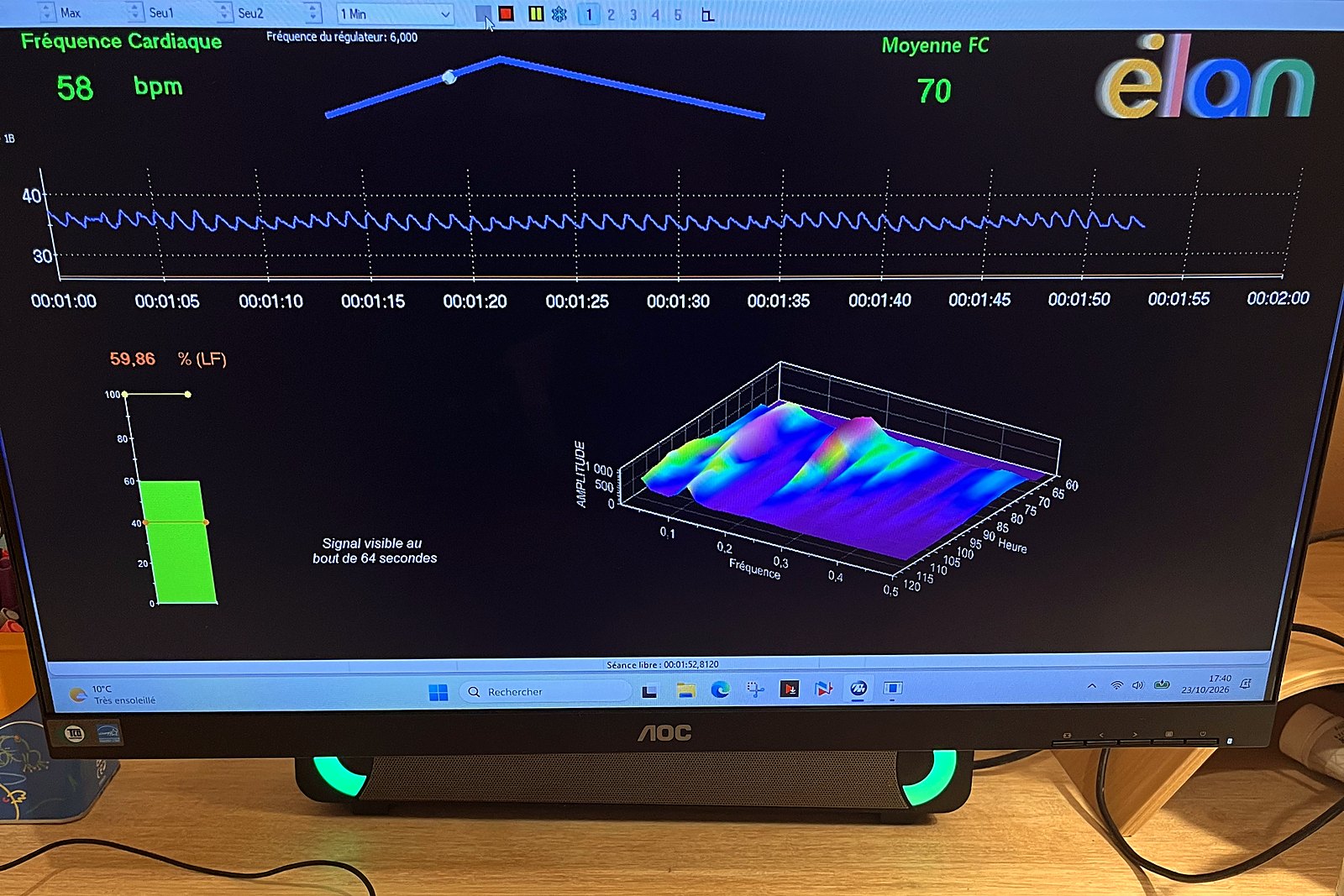
What is measured. A finger sensor (BVP) uses a small light to detect the surge of blood with each heartbeat (Allen, 2007). From this, the software calculates heart rate and its variability: the interval between two beats is constantly changing, partly under the influence of the parasympathetic brake.
The exercise. The heart speeds up slightly on the in-breath and slows down on the out-breath. The belt guides the breathing and the sensor shows how the heart follows, so the two are usually trained together (Lehrer & Gevirtz, 2014). At a rate specific to each person, these oscillations reach their maximum: this is cardiac coherence, at the resonance frequency. At the centre, we start with a standard rate of around six breaths per minute, then look, without forcing, for the rate that suits you best.
The finger pulse sensor and live heart rate, at the centre.
58 trialsrandomised and pooled: a small-to-moderate overall effectSource: Lehrer et al., 2020
Stress and anxietyFalling asleepPreparing for an examRecovery and performance
What the research says. This is the most widely studied form of biofeedback. A meta-analysis of 24 studies links it to a clear reduction in self-reported stress and anxiety, while calling for better-controlled studies (Goessl et al., 2017). Lehrer et al. (2020) find clearer effects on anxiety, depression and performance, and weaker effects on sleep; in athletes, the studies remain small (Jiménez Morgan & Molina Mora, 2017).
Electrodermal activity: a marker of arousal
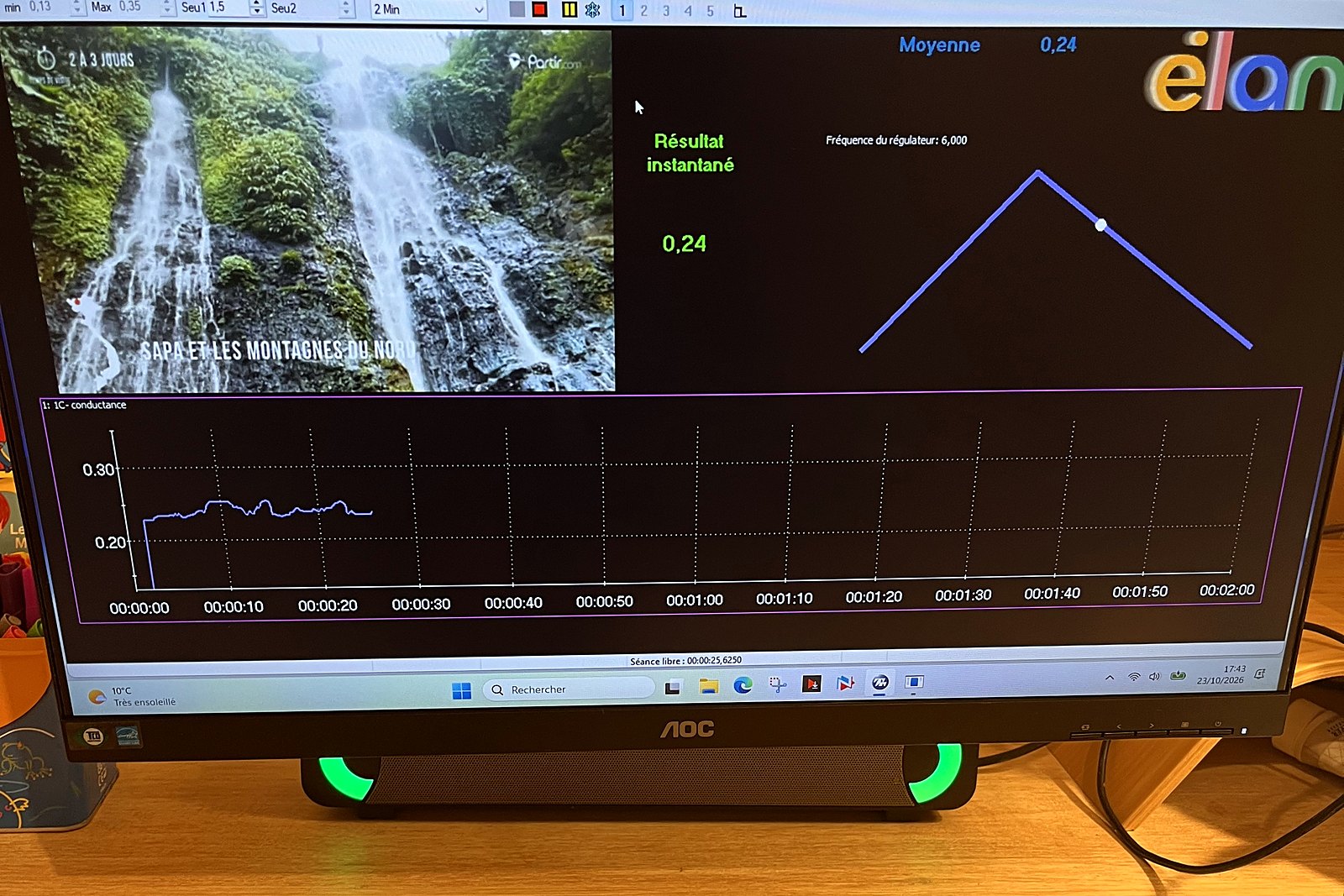
What is measured. Two electrodes on two fingers measure skin conductance: how easily a tiny current passes through the skin. It varies with invisible sweating controlled by the sympathetic branch, and therefore reflects arousal (Critchley, 2002; Posada-Quintero & Chon, 2020). It reacts within a few seconds to a surprise or a worrying thought, but it does not show which emotion you are feeling.
The exercise. Notice what makes the curve rise, then learn to bring it back down more quickly, through breathing or relaxation.
Electrodermal activity controls a video on screen.
Stress reactivityRuminationAnticipatory anxiety
What the research says. This signal is mostly trained alongside others. We have not found any meta-analysis of this form of biofeedback on its own for stress; the only review we identified concerns drug-resistant epilepsy (Nagai et al., 2019).
Surface EMG: relaxing muscles that are always tense
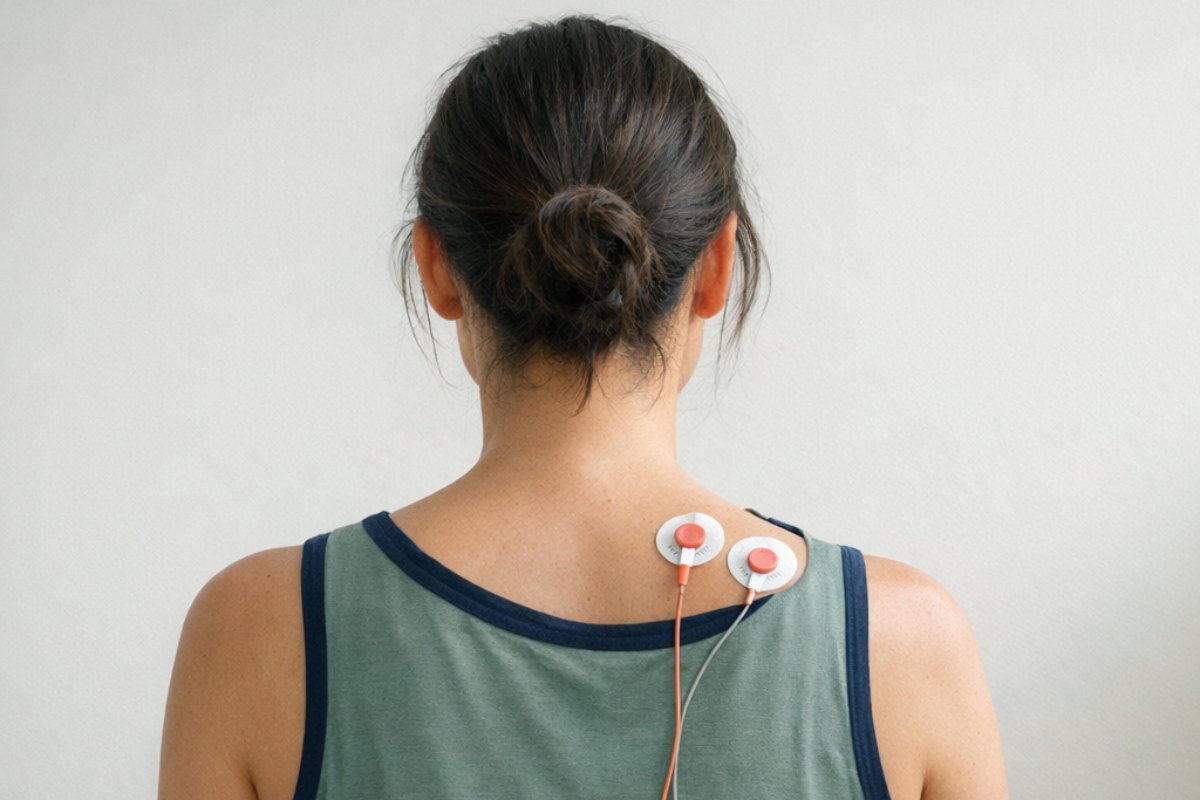
What is measured. Self-adhesive electrodes, placed over a muscle as needed (neck, trapezius, shoulders, back or jaw), pick up its electrical activity: this is surface electromyography. The screen shows tension that you no longer feel.
The exercise. Tense and then release to feel the difference, then keep this relaxation while talking, writing or during neurofeedback.
EMG electrodes on the trapezius to learn to relax the shoulders (illustration)
Tension headachesNeck and shouldersClenched jawBack pain
What the research says. For tension-type headache, a meta-analysis of 53 studies finds a medium-to-large, lasting effect, which is marked in children and adolescents (Nestoriuc et al., 2008). For chronic back pain, 21 studies show a small-to-medium effect on pain (Sielski et al., 2017).
Finger temperature: warming your hands
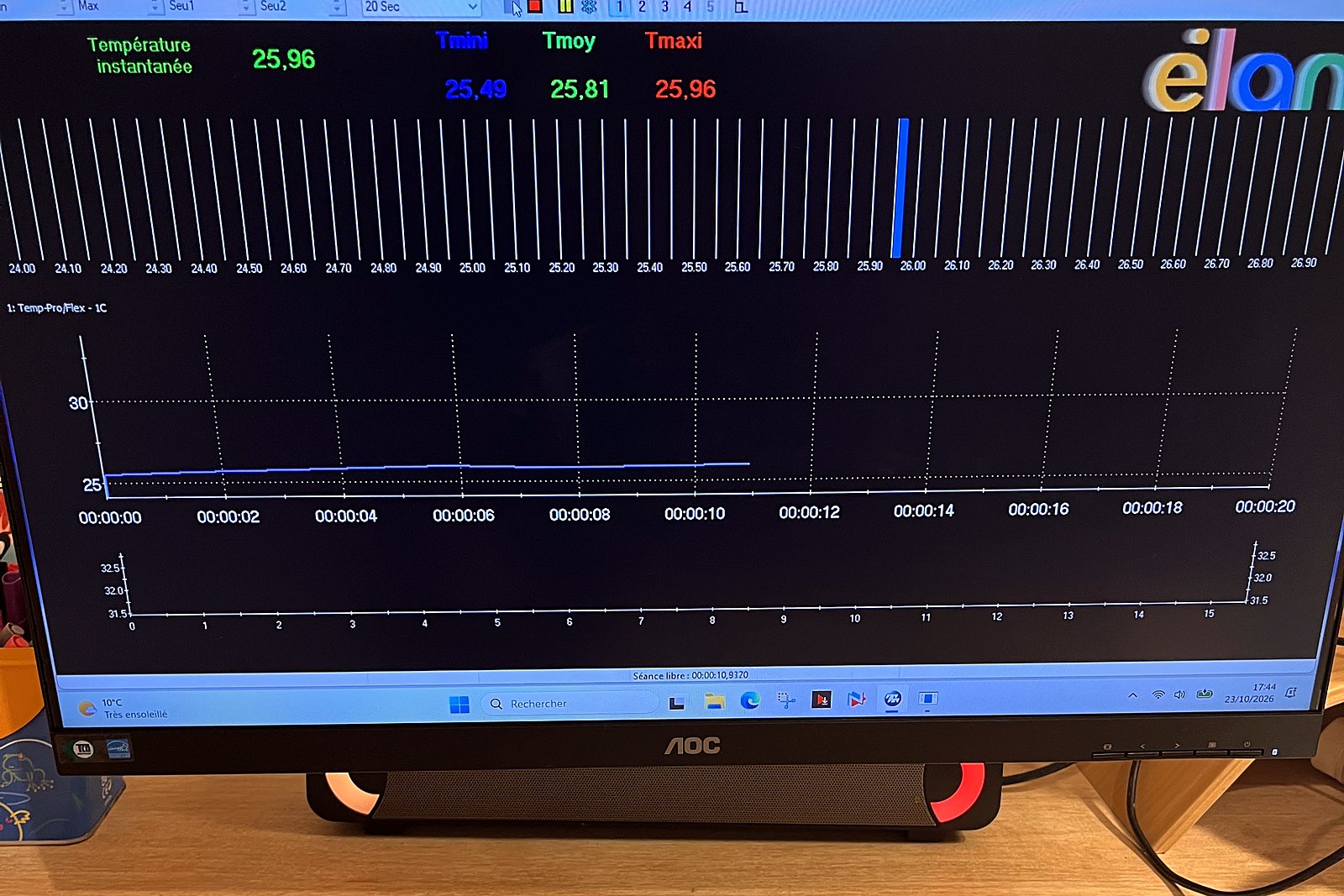
What is measured. A small probe on a fingertip tracks skin temperature to a tenth of a degree. Under stress, the small blood vessels in the hands narrow and the fingers cool down; when you relax, they open up again.
The exercise. Warming your hands through breathing, relaxation and images of warmth. A slow signal: a good exercise in patience.
Finger temperature, displayed live.
Cold hands under stressMigraine, alongside medical follow-upRelaxing before bed
What the research says. For migraine, a meta-analysis of 55 studies finds a medium effect of biofeedback, stable over about 17 months (Nestoriuc & Martin, 2007). In children, five trials show fewer attacks than in waiting-list controls, with no advantage over other active approaches (Stubberud et al., 2016). In Raynaud’s phenomenon, thermal biofeedback did no better than control biofeedback (Raynaud’s Treatment Study, 2000).
The five signals at a glance
Signal
Sensor
What it reveals
Typical exercise
Breathing
Belt worn over clothing, on the chest or belly
Rate, amplitude, regularity, pauses, high or low breathing
Breathing more slowly and lower, including while concentrating
Pulse (BVP)
Fingertip sensor
Heart rate and its variability
Cardiac coherence, with the belt
Electrodermal activity
Two electrodes on the fingers
Arousal level, reactivity
Bringing arousal back down after a stimulus
Surface EMG
Electrodes on the neck, trapezius, shoulders, back or jaw
Muscle tension
Releasing tension, then maintaining the relaxation
Starting pointYour week: sleep, stress, exercises you have done.
Fitting the sensorsPainless: a belt over your clothes, finger sensors and electrodes.
BaselineA few quiet minutes to see where your signals stand.
TrainingGuided exercises, often combining body and brain.
For homeA simple exercise, chosen together.
At the start of your programme, a stress profile may be recorded: your signals at rest, during a short stressful task, and then during recovery.
Body and brain: holistic support, combined training
Stress in itself is perfectly normal: it is the body gearing up. According to Institut Neurosens, the problem begins when recovery no longer happens (Institut Neurosens, 2026). The two levels then feed into each other: the body races and the mind worries. At the centre, we help you learn to manage several components of stress at once.
Physical stressobserved → trained
Racing heart → pulse, cardiac coherence
Shallow, high or held breathing → belt, slow and low breathing
Rumination → seeing the effect of a thought on screen, then neurofeedback based on the assessment
Hypervigilance → learning to come back down, backed by measurements
Difficulty concentrating → neurofeedback with steady breathing
Difficulty “switching off” in the evening → slow breathing, then sleep-focused training
Why train them together?
The brain and body are in constant dialogue through the autonomic nervous system: breathing and heartbeat send information to the brain, and our thoughts in turn change pulse, breathing and muscles. The neurovisceral integration model links the brain regions involved in emotional regulation to heart rate variability (Thayer & Lane, 2000), and slowing your breathing also changes the brain’s electrical activity (Zaccaro et al., 2018).
Our approach is rooted in the integrative neurotherapy taught by Institut Neurosens, which describes five pillars that depend on one another: when one becomes dysregulated, the others compensate (Institut Neurosens; 2026).
Muscle tone and postureBreathingSleepEmotionsCognition and attention
The Institut sees emotions as a “language of the living”, to be understood before trying to silence them (2026), and biofeedback as a “pedagogy of reversibility”: the aim is not to stop feeling stress, but to be able to return to calm more and more easily (2026). Hence the rule of Joël Lemaire, co-founder of the Institut: “first the system, then the networks”. These are working hypotheses, consistent with physiology, not established facts.
What does a combined session look like?
In the Institut’s programmes, cardiac coherence often precedes or accompanies neurofeedback (Institut Neurosens, in French: biofeedback, support). At the centre, each session is based on your assessment, for example:
Calming the bodySlow breathing, then cardiac coherence, with belt and pulse on screen.
Checking the “indicator lights”Relaxed shoulders (EMG), arousal coming down; if not, we stay with the body.
NeurofeedbackTailored to your qEEG assessment, while keeping your breathing steady and your shoulders down.
Putting it into practiceA small, concrete task, with breathing breaks along the way.
During neurofeedback, the film can be set to continue only if the target brain activity is reached and the shoulders are relaxed: the brain learns in a calm body. See also swLORETA neurofeedback.
Another example: training to recover. Faced with a short stressful task (timed mental arithmetic, for example), your pulse rises, your skin reacts and your breath catches; you then learn to return to calm, faster and faster. According to Institut Neurosens, what matters is not so much how high the peak is as how long it takes to come back down (2026). See also our anxiety and stress page.
Between sessions: carrying it into real life
Before an exam or a meeting
One to two minutes of slow breathing, at the rate you found in your sessions.
At bedtime
Slow breathing, relaxed shoulders: the body lets go. See sleep problems.
During homework or at work
Short breaks: I breathe, I relax, I get back to it.
You do these exercises without sensors, for a few minutes a day: consistency is what counts.
What the research says about combined training. It remains limited. A review of 63 studies cautiously suggests an advantage for multi-signal protocols (Schoenberg & David, 2014). A retrospective study of 183 children and adults (neurofeedback and cardiac biofeedback) reports fewer anxiety and depressive symptoms, but without a control group and conducted by the centre that offered the training (White et al., 2017). A small randomised trial in 34 older adults, combining cardiac biofeedback with another form of neurofeedback, shows an improvement on only one of the two tasks (Tinello et al., 2023). Combining body and brain is consistent with physiology; its superiority over each method on its own has not been demonstrated.
What you can expect, and what biofeedback does not do
What you can reasonably expectwith regular training
Spotting your tension signals earlier
A better sense of the link between breathing, tension and thoughts
Practical tools you can use anywhere
Faster recovery after a peak of stress
More confidence in your ability to calm yourself
What it does not doour limits
Make a diagnosis
Replace treatment, psychotherapy or remedial therapy
Guarantee a result: responses vary from one person to another
Work without practice between sessions
Remove the causes of stress
See your doctor first if you have new or changing headaches, unusual pain, palpitations, faintness or breathlessness. If you have asthma or a heart or lung condition, please tell us so that we can adapt the breathing exercises.
Other forms of biofeedback, which we do not offer
Form
What it involves
Who to turn to
Pelvic floor
Sensors show the contraction of the pelvic floor muscles, for urinary leakage (Herderschee et al., 2011).
Physiotherapist or midwife, on medical advice
Anorectal
Coordinating pushing and relaxing, for constipation (Rao et al., 2015).
Gastroenterologist or proctologist
Motor rehabilitation
After a stroke or an injury, a movement signal helps to relearn a movement (Stanton et al., 2017).
Physiotherapist, rehabilitation physician
Capnometry
Measuring exhaled CO2 to correct overbreathing, studied in panic disorder (Meuret et al., 2008).
Your doctor, who will refer you
Haemoencephalography (HEG)
A sensor on the forehead tracks oxygenation in the front of the brain; few studies (Toomim et al., 2004).
Practitioners who explicitly offer it
Blood pressure
Studied in high blood pressure, without consistent evidence of effectiveness (Greenhalgh et al., 2009).
GP (family doctor) or cardiologist
Postural or stabilometric
A platform shows the body’s sway in order to work on balance (Zijlstra et al., 2010).
Physiotherapist, ENT or rehabilitation physician
fMRI neurofeedback
Regulating a brain area inside an MRI scanner; effects on behaviour rarely replicated (Thibault et al., 2018).
Research protocols only
A complementary form of training. Biofeedback, on its own or combined with neurofeedback, is training in self-regulation. It does not replace a diagnosis, medical or psychological follow-up, or remedial therapy (physiotherapy, speech and language therapy, orthodontics). No treatment should be stopped or changed without your doctor’s advice.
Frequently asked questions
Do the sensors hurt? Do they send an electric current?
No. They are placed on the skin, or over clothing in the case of the belt, and they only measure. For electrodermal activity, a tiny, imperceptible current flows between two fingers: nothing is stimulated.
Why combine biofeedback and neurofeedback?
Because stress plays out in both the body and the mind. Calming the breathing and tension first often helps with the neurofeedback training that follows. The balance between the two depends on your assessment; research on these combinations remains limited.
Is biofeedback suitable for children?
Yes, from the age of 5. The screens are playful, the exercises are shorter, and the breathing rate is adapted to the child’s age.
How long does it take to notice a difference?
It varies. Some people feel calmer from the first few sessions; a lasting habit takes several weeks of regular training. No result is guaranteed.
Do I need a device at home?
No. The exercises are practised without sensors; the sessions are a chance to check that you are doing them correctly.
Thought Technology. Biofeedback Expert System: BioGraph Infiniti software and sensors (respiration belt worn on the chest or abdomen, BVP pulse, skin conductance, temperature, EMG).
To provide the best experiences, we use technologies such as cookies to store and/or access device information. Consenting to these technologies will allow us to process data such as browsing behaviour or unique IDs on this site. Not consenting, or withdrawing consent, may adversely affect certain features and functions.
Functional
Always active
The technical storage or access is strictly necessary for the legitimate purpose of enabling the use of a specific service explicitly requested by the subscriber or user, or for the sole purpose of carrying out the transmission of a communication over an electronic communications network.
Preferences
The technical storage or access is necessary for the legitimate purpose of storing preferences that are not requested by the subscriber or user.
Statistics
The technical storage or access that is used exclusively for statistical purposes.The technical storage or access that is used exclusively for anonymous statistical purposes. Without a court order, voluntary compliance on the part of your internet service provider, or additional records from a third party, information stored or retrieved for this purpose alone cannot usually be used to identify you.
Marketing
The technical storage or access is required to create user profiles to send advertising, or to track the user on a website or across several websites for similar marketing purposes.