qEEG assessment, biofeedback and neurofeedback: tools for functional analysis and training, working with occupational health, as part of psychosocial risk prevention.
Psychosocial risks cover work-related stress and internal or external violence (INRS, the French national institute for occupational health and safety). Their impact keeps growing:
Under French law, employers must take the necessary measures to protect workers’ physical and mental health, giving priority to collective prevention (Article L4121-1 of the French Labour Code). Our services complement this approach and never replace it.
Centre Élan works with occupational health and prevention services (services de prévention et de santé au travail). In December 2023, Sarah Dehan presented qEEG-guided neurofeedback at the Occupational Health and Prevention Days of a major industrial group, alongside the group’s occupational physician. The centre also supports employees referred by their occupational health service.
At the employer’s request, Sarah Dehan comes to your company’s premises to carry out the qEEG assessments, followed by training and follow-up sessions for employees who wish to continue. Your company then makes access easier: it provides a quiet room, so employees don’t need to travel. Sessions can equally take place at the occupational health service.
At the occupational physician’s request and with the employee’s agreement, the qEEG assessment offers a functional perspective: arousal level, signs of fatigue or hypervigilance, attention capacity, considered alongside the difficulties described and the in-depth initial interview. It also helps design targeted training and then measure progress.
An over-aroused or under-aroused brain, considered alongside the difficulties described.
Signs of fatigue, tension or being constantly on alert.
Insights into sustained attention, to help target the training.
It complements the occupational physician’s assessment; under French law, only the occupational physician can rule on fitness for the job and workplace adjustments (Article L4624-4 of the French Labour Code).
Receives their individual results and stays in control of them.
Receives the results if the employee agrees.
No individual results: only collective, anonymised feedback.
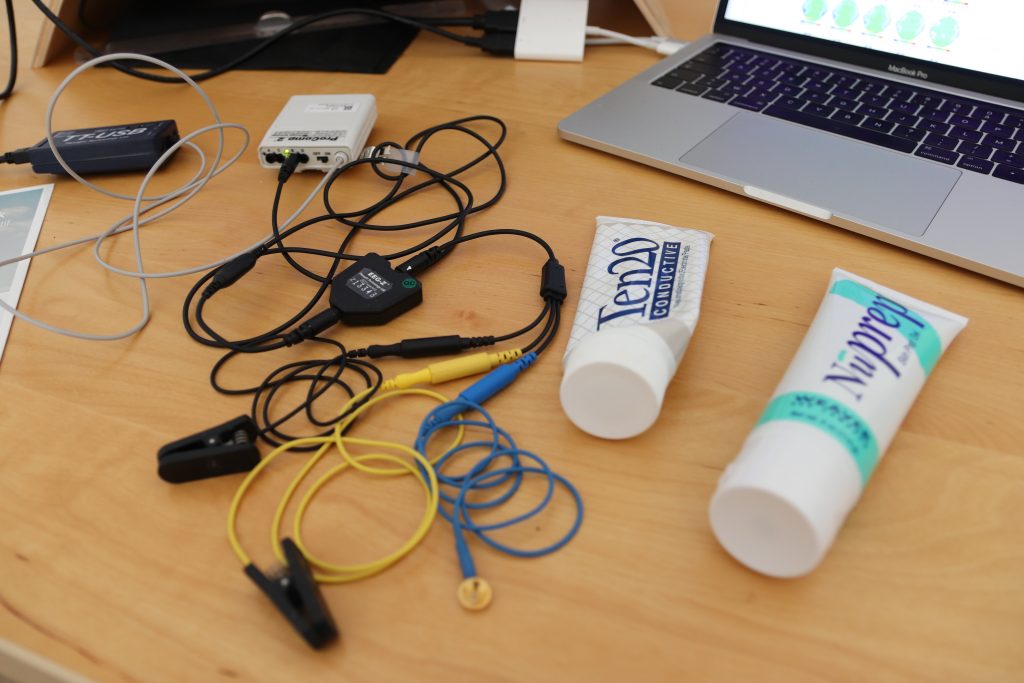
Biofeedback makes breathing, heart rate and muscle tension visible, so you can learn to bring your stress level down. Heart rate variability (HRV) biofeedback is one of the best-studied self-regulation approaches: a meta-analysis of 24 studies reports a clear reduction in self-reported stress and anxiety (Goessl et al., 2017), and a review of nine workplace studies concludes there are positive short-term effects on employees’ stress, anxiety and depressive symptoms, although sample sizes are still small (Ferreira et al., JMIR, 2025).
For executives and managers facing a heavy cognitive load and the pressure of decision-making, neurofeedback can be offered as mental preparation: training sustained attention, recovery and the ability to stay calm under pressure. In healthy adults, studies report gains in attention, memory and mood after training (Gruzelier, 2014): a promising avenue, though the evidence still needs to be strengthened. That is how we present it.
Staying focused over time, despite distractions.
Knowing how to release pressure and recover better.
Staying in control when decisions have to be made.
In France, working people sleep an average of 6 hours 48 minutes per 24 hours, and 13% of adults suffer from chronic insomnia (Santé publique France, 2019). Poor sleep directly affects concentration, mood and safety. We offer support combining an assessment, relaxation biofeedback and practical tips, and refer people for medical care or cognitive behavioural therapy for insomnia (CBT-I) when needed.
Format 1
An awareness session on stress, sleep and attention, with a live biofeedback demonstration. Ideal for a workplace wellbeing week (Semaine de la qualité de vie au travail).
Format 2
qEEG assessments for employees referred by the occupational health service, carried out on your premises, at the occupational health service or at the centre, with a feedback session for the employee.
Format 3
One-hour biofeedback and neurofeedback sessions, on your premises in a room you provide, at the occupational health service or at the centre, with a follow-up assessment to measure progress.
Format 4
Tailored support for attention, recovery and managing pressure.
We provide a quote tailored to your organisation for each service. An itemised invoice is issued for every service; VAT is not applicable.
No employee is supported without their written consent.
No individual data is shared with the employer; only collective, anonymised feedback may be shared.
Our services complement collective prevention and medical care, without replacing them.
The qEEG assessment is a functional reading used to guide the training.
No. Only the occupational physician can rule on whether someone is fit or unfit for their job. The qEEG assessment can inform their evaluation, at their request and with the employee’s agreement, but it does not decide anything.
No. Individual results are given to the employee and, with their agreement, to the occupational physician. At most, the employer receives collective, anonymised feedback.
At the employer’s request, everything can take place on your premises: talks, workshops, qEEG assessments and training sessions, in a quiet room you provide. Sessions can also take place at the occupational health service, or at the centre in Brétigny-sur-Orge (south of Paris).