From first contact to independence: the practical steps of neurofeedback and biofeedback support at Centre Élan in Brétigny-sur-Orge, near Paris.
Every programme follows the same main stages, which are then adjusted to your goals. On average, a programme includes around thirty sessions: an initial qEEG assessment, about 15 training sessions, a comparative mid-point assessment, then about 15 adjusted sessions. This structure is in line with the one described by Institut Neurosens, where a second quantitative EEG is used to assess progress objectively after a first phase of around fifteen sessions.
The typical programme, adjusted for each person at the mid-point assessment.
It all starts with a conversation, by phone, by message or via the contact form. We listen to your request, or your child’s, and check together whether the approach can address it. If a significant difficulty has never been assessed, we first refer you to the appropriate professionals: your GP (family doctor), a paediatrician or a specialist team. Parents can also get a first overview with our parent questionnaire. The assessment appointment can then be booked online or by phone.
The assessment draws on several sources of information to understand how you function as a whole; the quantitative EEG (qEEG) is only one part of it.
An in-depth interview: development, sleep, school or work, health, current support, and above all your priorities.
Chosen to suit the person’s age and needs, they provide a baseline for measuring progress.
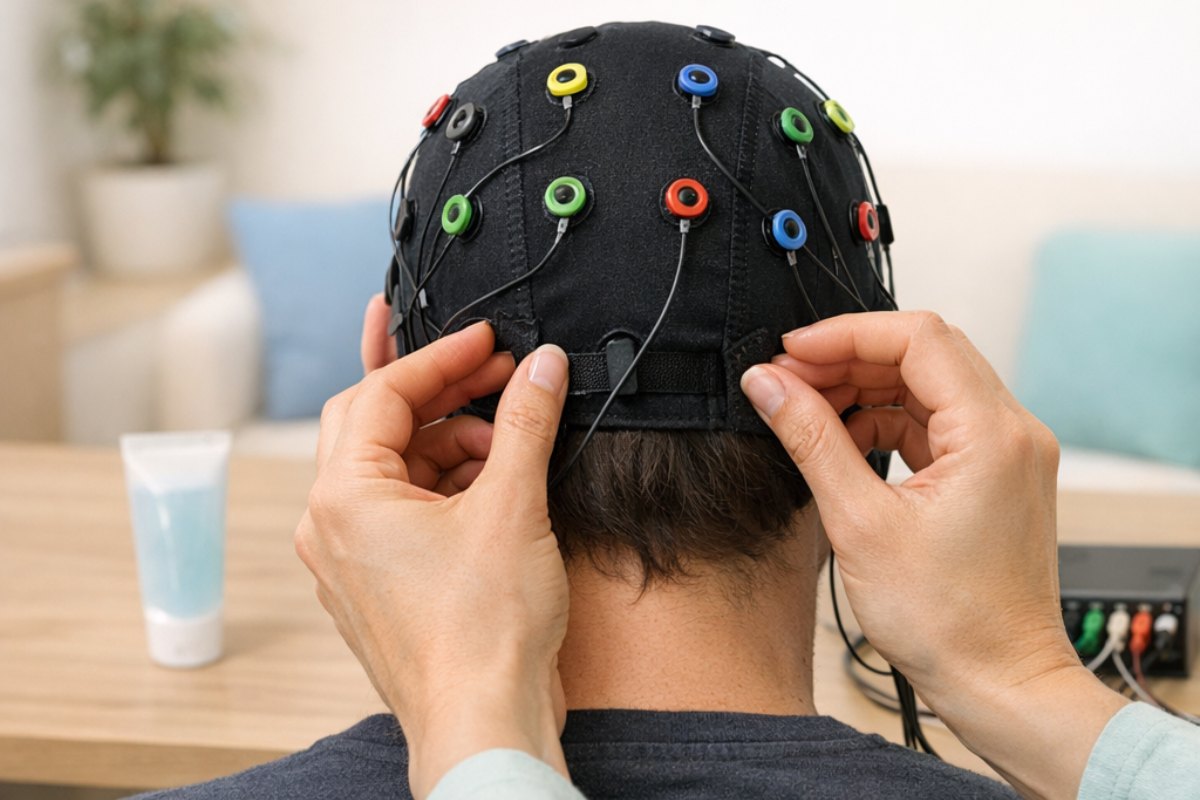
A 19-electrode cap records brain activity at rest, first with eyes open, then with eyes closed.
Posture, weight distribution, muscle tone and breathing pattern (nose or mouth), which influence alertness, sleep and stress.
| Questionnaire | What it covers | Who completes it |
|---|---|---|
| SDSC | 26 questions on sleep: falling asleep, night waking, breathing at night, sleepiness | Parents, for children and teenagers |
| BAI | 21 symptoms of anxiety, mainly physical | The adult themselves |
| SNAP-IV | Inattention, hyperactivity-impulsivity and oppositional behaviour (26-item version) | Parents and, where possible, the teacher |
| Postural questionnaire | Posture, balance, muscle tone, proprioception | The person or their parents, depending on age |
These tools have been validated in international research (Bruni et al., 1996; Beck et al., 1988; Bussing et al., 2008). They do not provide a diagnosis: they give a measurable starting point, which is then compared with the results of the mid-point assessment.
The 19 electrodes are placed according to the international 10-20 system, which covers the whole scalp. The trace is first inspected visually, then cleaned of artefacts (eye blinks, clenched jaws), analysed with NeuroGuide software and compared with a normative database of people of the same age (Applied Neuroscience). The technical guidelines published in 2025 by the IQCB (International QEEG Certification Board) are a reminder that the reliability of a quantitative EEG depends first and foremost on the quality of the recording, the inspection of the trace and the handling of artefacts (Collura et al., 2025). The procedure is painless: the electrodes record without sending any current.
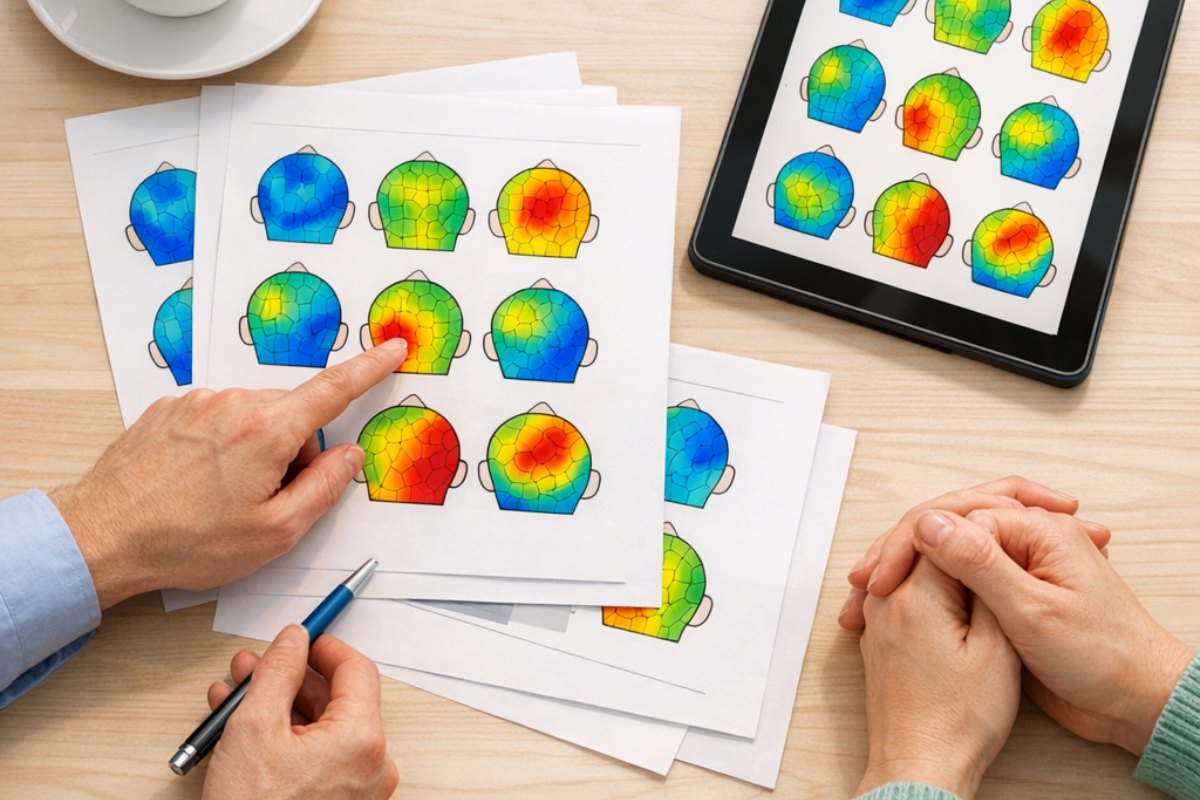
To understand what the brain maps show, read our article qEEG assessment: procedure and brain mapping.
The data are then analysed and presented at a feedback session. We explain the results in plain language, relating them to your everyday experience: what is working well, what deviates from the reference values of the normative database and what can be trained. As Neurofeedback Luxembourg sums it up, the norm and normality should not be confused: a deviation from the average is not a problem in itself, and only takes on meaning in light of your daily life. You will receive a written report. The assessment does not provide a diagnosis: it describes how you function, without labelling.
The personalised protocol specifies the brain areas or networks to be trained, the biofeedback methods chosen and the lifestyle advice. For neurofeedback, there are two options: swLORETA Z-score neurofeedback, with a 19-electrode cap, or personalised two-channel neurofeedback, carried out with BioGraph Infiniti software (Thought Technology). Biofeedback is chosen according to your needs:
The overall rationale behind these tools is presented on the Integrative neurotherapy page.
Each training session follows a consistent structure, adjusted as you progress:
To motivate younger children and recognise their commitment, a points system lets them earn small prizes over the course of their sessions. The recommended pace is one to two sessions a week: regularity matters more than intensity. Neurofeedback Luxembourg also stresses that sessions spaced too far apart, especially at the start, slow down learning. Together, we build a schedule that fits around school, work and family life.
After around fifteen sessions, a new quantitative EEG is recorded under the same conditions as the first. Three sources are then compared to track progress objectively and adjust the protocol for the second phase of about 15 sessions:
Initial and mid-point assessments compared side by side.
Completed again, to measure how the scores have changed.
Your own day-to-day observations and those of the people around you.
The aim is not to depend on sessions, but to gain independence. This is in line with the international definition of biofeedback adopted by the AAPB, the BCIA and the ISNR: learned changes may, over time, be maintained without the equipment. Throughout the programme, the person learns to recognise their own states (restlessness, fatigue, tension) and to use the techniques they have practised without help: breathing, cardiac coherence, breaks, sleep routines. The end of the programme is decided together, in light of the goals set at the feedback session. Soon, the Élan Minds app will make it possible to carry some of these reference points into everyday life.
Around thirty on average, split into two phases of about 15 sessions either side of the mid-point assessment. This number varies depending on the person and their goals; it is reviewed at the mid-point assessment.
One to two one-hour sessions a week. A regular pace supports learning; together, we build a schedule that fits around school, work and family life.
No. It is not used to make a diagnosis: it describes brain function at rest and guides the training. It does not replace a doctor’s opinion, and we will refer you to a doctor if necessary.
No. The cap is fitted with a conductive gel and the electrodes simply record. Come with clean, dry hair and no styling products.
Yes, and it is actually encouraged. With your consent, we can liaise with the professionals who support you, or who support your child.