The essentials in 30 seconds
At Centre Élan, every neurofeedback programme begins with a quantitative EEG (qEEG) assessment. This is what allows us to understand how your brain works, build tailored training and then measure progress objectively. Here is how it works, what it shows and how to prepare for it.
What is a quantitative EEG?
The electroencephalogram (EEG) records the brain’s electrical activity using sensors placed on the scalp. It is a non-invasive, painless examination: the sensors simply listen, and no current is sent.
The EEG is called “quantitative” because the recording is then analysed by software. It measures the power of brain activity at each frequency, from slow waves to fast waves, then compares it with a normative database, that is, recordings of people of the same age. The deviation from this norm is expressed as Z-scores.
The sensors are placed according to the international 10-20 system, used all over the world, which makes it possible to compare each region of the brain with the norm.
Why have an assessment before neurofeedback?
Because no two brains are alike. Two children who struggle to concentrate may show very different profiles. The qEEG assessment helps to:
- personalise the training: choose the areas and frequencies to work on, rather than applying the same programme to everyone;
- link the measurements to the clinical picture: compare what we see on the brain maps with the difficulties you describe in daily life;
- measure progress: a mid-point assessment, compared with the first one, lets us check objectively what has changed and adjust the protocol.
This is the key difference from so-called dynamical neurofeedback, which we explain in our article Dynamical neurofeedback or qEEG: what’s the difference?
How does the qEEG assessment work at Centre Élan?
1. The recording session
The first appointment begins with an in-depth initial interview: your history or your child’s, the difficulties you face, sleep, school or work, any current care or treatment and, above all, your goals. Depending on age and the reason for coming, questionnaires add to this discussion, for example on sleep, anxiety or attention.
Next comes the recording. A cap fitted with sensors is placed on the head, with a gel that ensures good contact. The recording is made at rest, with eyes open and then eyes closed, for a few minutes. All you need to do is stay calm and relaxed.
2. The analysis
Between the two appointments, the recording is carefully cleaned of artefacts (eye blinks, movements, muscle tension), then analysed: power at each frequency, comparison with the normative database, communication between the different regions of the brain.
3. The feedback session
At a second appointment, we present your brain maps and what they mean, in relation to the difficulties you described. We then suggest a personalised training protocol combining neurofeedback and biofeedback, together with a cost estimate.
What does a brain map show?
Each small head represents the brain seen from above, for a given frequency. The colours show the deviation from the norm: green corresponds to activity close to the average for people of the same age, red to excess activity, blue to a deficit.
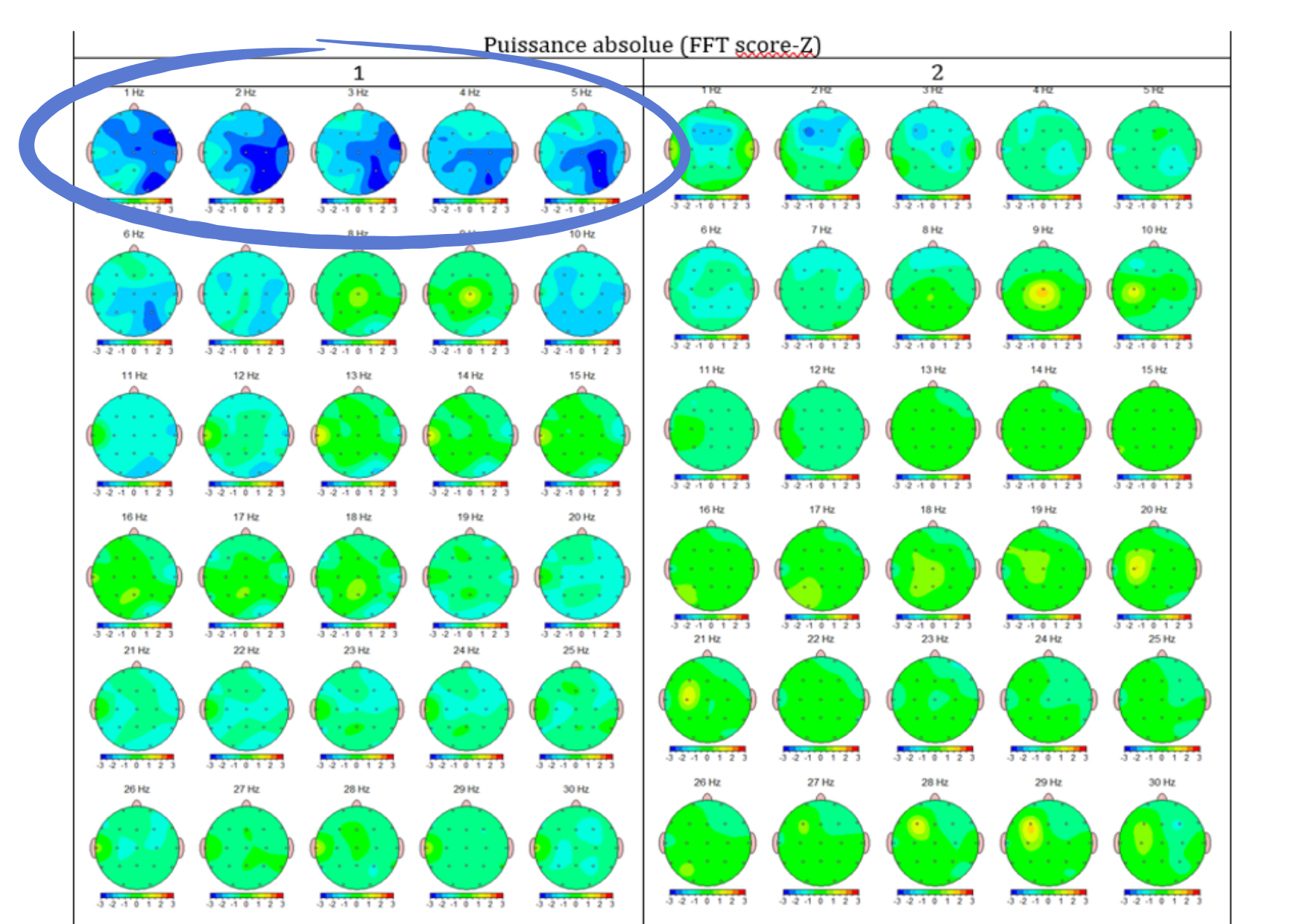
Some profiles come up often, for example excess slow-wave activity in the frontal regions, or excess fast activity associated with a state of hypervigilance. But no brain map is read in isolation: it only becomes meaningful when considered alongside the person’s history and what they experience day to day.
What the qEEG assessment is not
- It is not a diagnosis. Diagnosing ADHD, autism spectrum disorder (ASD) or a specific learning difficulty is a matter for doctors and qualified professionals. The qEEG assessment is a functional reading, used to guide training.
- It is not a medical EEG. It does not look for epilepsy or any other illness, and it does not replace an EEG requested by a doctor.
- It is not an end in itself. Its value lies in what it makes possible next: targeted training and progress that can be measured.
Preparing for your qEEG assessment
- Come with clean, dry hair, with no gel, hairspray or oil.
- Get a good night’s sleep beforehand and avoid stimulants (coffee, tea, fizzy drinks) for a few hours before.
- Tell us about any current treatment, but never stop it for the assessment.
- Bring any existing reports: speech and language therapist, neuropsychologist, doctor, school reports.
- If the assessment is for your child, simply explain that we are going to “listen to their brain” with a cap, and that it doesn’t hurt at all.
After an initial protocol of about 15 sessions, a mid-point qEEG assessment, compared with the first one, allows us to take stock and adjust the next steps. To find out more, see our programme, from qEEG assessment to training, or contact the centre.
Frequently asked questions about the qEEG assessment
Is the qEEG assessment painful?
No. The sensors placed on the scalp simply record the brain’s electrical activity: no current is sent. The only requirement is to stay calm for a few minutes during the recording.
From what age can you have a qEEG assessment?
Centre Élan sees children from the age of 5, teenagers and adults. With younger children, the recording is presented as a game and adapted to the child’s pace.
Can the qEEG assessment be used to make a diagnosis?
No. The qEEG assessment is a functional reading of brain activity, used to build and monitor training. Diagnosing a disorder (ADHD, ASD, specific learning difficulties…) is a matter for doctors and qualified professionals, and the assessment does not replace a medical EEG requested by a doctor.