The essentials in 30 seconds
When you look for neurofeedback support for your child or for yourself, you quickly come across two families of approaches that share the same name but work in very different ways: dynamical neurofeedback and neurofeedback guided by quantitative EEG (qEEG). This article explains what sets them apart, what the research says, and the questions to ask before choosing a practitioner.
The common ground: training through feedback
In both cases, neurofeedback is a form of biofeedback applied to the brain. Sensors placed on the scalp measure the brain’s electrical activity in real time, and visual or auditory feedback lets the person know what is happening. With repetition, the brain learns to change the way it works. Neither method sends any electrical current to the brain or stimulates it: the sensors simply listen.
The difference comes down to a simple question: what is being trained, and how is that decided?
Dynamical neurofeedback: based on global self-regulation
Dynamical neurofeedback (sometimes called “automatic” neurofeedback) is based on the idea of global self-regulation. The best-known example is the NeurOptimal® system. The software continuously analyses the brain signal and, when it detects certain variations, briefly interrupts the music or film the person is listening to or watching. These micro-interruptions are supposed to allow the brain to readjust by itself.
- No prior assessment: the session starts without an initial recording or brain map.
- No individual protocol: the programme is the same for everyone, whatever the reason for coming.
- Very easy to use: few settings, short sessions, an accessible method.
Its manufacturer also presents it as a non-medical wellbeing tool that does not target any particular disorder.
Neurofeedback guided by quantitative EEG (qEEG): tailored training
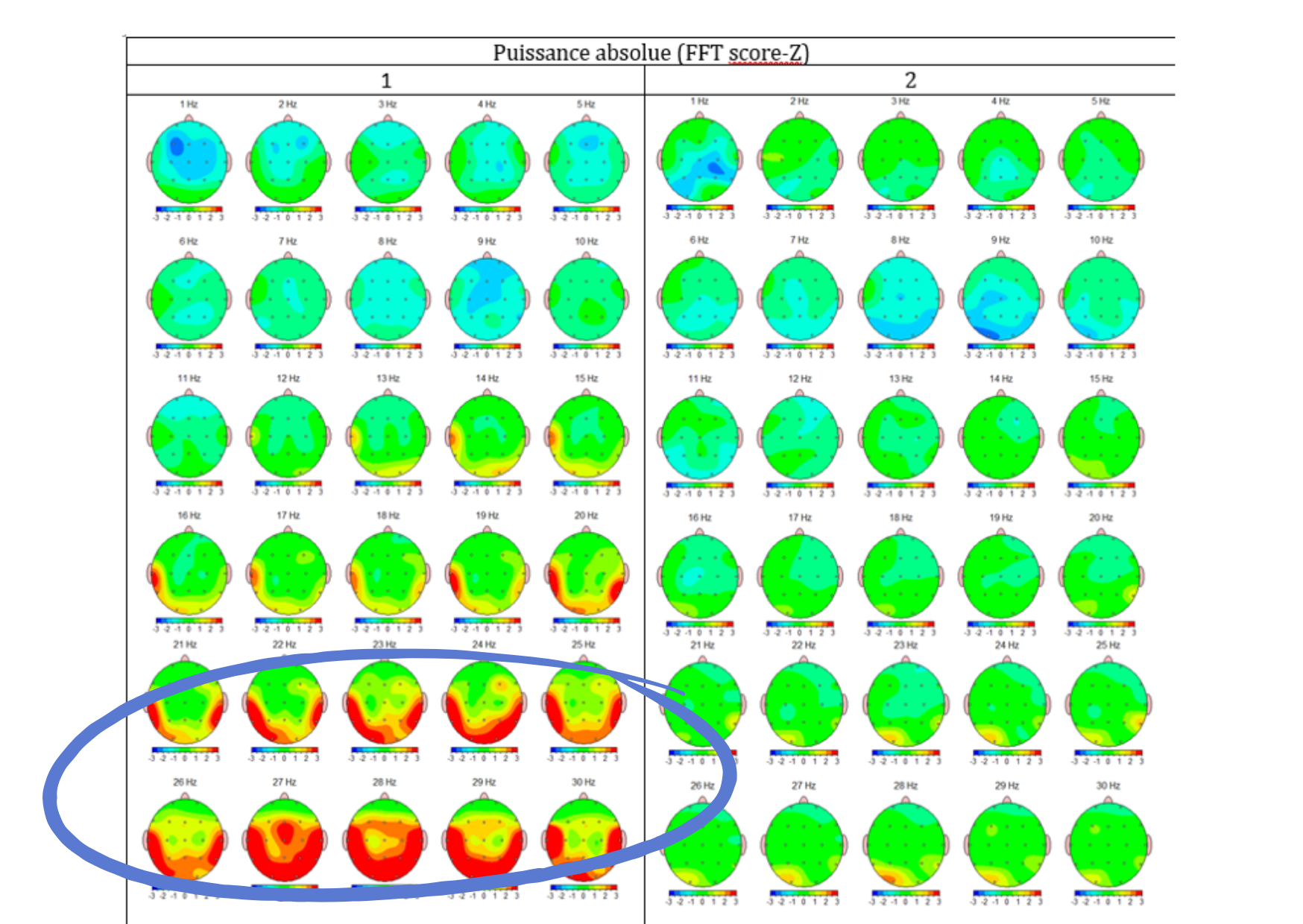
Neurofeedback guided by quantitative EEG (qEEG) begins with a measurement stage. The brain’s electrical activity is recorded at 19 points on the scalp, then compared with a normative database, that is, recordings of people of the same age.
In practice, this comparison is expressed as Z-scores, which show how far a measurement is from the average. It produces a brain map showing, frequency by frequency, the areas whose activity departs from the norm. The practitioner then cross-references these results with the in-depth initial interview – the person’s history, difficulties and goals – to build an individualised protocol.
- A tailored protocol: training targets the areas and frequencies that genuinely deviate from the norm in that particular person.
- More refined techniques: using the 19 electrodes, swLORETA neurofeedback estimates the activity of deeper brain regions and allows them to be trained directly.
- Measurable progress: a mid-point qEEG assessment, compared with the first one, lets us check objectively what has changed and adjust the protocol.
The trade-off is that this approach requires an initial assessment, time for analysis and a practitioner trained in reading quantitative EEG.
Dynamical neurofeedback or qEEG: the two approaches at a glance
What the research says about dynamical and guided neurofeedback
It is important to be clear on this point, as there are many contradictory claims out there.
Points to be aware of
- ADHD is the most studied area. A meta-analysis published in 2025 in JAMA Psychiatry (38 trials) found no significant benefit when only “blinded” assessments were taken into account. However, when limited to trials using validated standard protocols, it found a small but significant effect.
- The French National Authority for Health (HAS) does not recommend neurofeedback for the specific treatment of ADHD (2024 guidelines), given the lack of sufficient evaluation, and calls for further studies.
- Dynamical neurofeedback has been the subject of very few studies published in peer-reviewed scientific journals.
- Z-score and swLORETA neurofeedback is more recent: a literature review published in 2019 (Coben, Hammond and Arns) considers the evidence still limited, with encouraging early results for LORETA, particularly in ADHD and tinnitus, which need to be confirmed.
What recent international research shows
Research from English-speaking countries also provides encouraging results. All of it concerns targeted, protocol-based neurofeedback – specific protocols chosen and adjusted by a practitioner – and not dynamical neurofeedback.
- Recognised protocols. A key review (Arns et al., 2020) rates the standard ADHD protocols (theta/beta, SMR, slow cortical potentials) as “efficacious and specific”, the highest level on its evidence scale.
- Lasting effects. A meta-analysis of controlled trials (Van Doren et al., 2019) shows that the effects of neurofeedback on attention are maintained, and even strengthened, 2 to 12 months after the end of training.
- A protocol chosen on the basis of quantitative EEG. In a Dutch multicentre study (Krepel et al., 2020) involving 114 patients with ADHD, the protocol was chosen on the basis of each person’s quantitative EEG and combined with coaching and sleep advice. Seven out of 10 patients saw their symptoms fall by at least half, and more than one in two achieved remission. This was an open-label study with no control group, but its results confirm those of an earlier pilot study.
- In children. A network meta-analysis published in 2024 in Brain and Behavior (13 trials, 1,370 children aged 5 to 11) concludes that most neurofeedback protocols perform better than placebo on ADHD symptoms.
- Beyond ADHD: post-traumatic stress. In a US randomised trial (van der Kolk et al., 2016), after 24 sessions, 27% of the trained participants still had post-traumatic stress disorder (PTSD), compared with 68% in the waiting-list group. A Canadian double-blind, placebo-controlled trial (Nicholson et al., 2023) observed improvement only in the group that actually received training, with 60% remission three months after the end of the programme.
In summary: dynamical neurofeedback or a targeted protocol?
No trial has yet directly compared dynamical neurofeedback with qEEG-guided neurofeedback. However, targeted protocols, chosen and adjusted by a practitioner, have a much larger body of research behind them, with encouraging and lasting results for several conditions. This is also the strength of the qEEG-guided approach: personalised training, and progress that can be measured objectively, assessment after assessment.
Dynamical or guided neurofeedback: 5 questions to ask the practitioner
- Is an assessment carried out before starting? At how many sites, and compared with which norm?
- Is the protocol adapted to my profile? How is it chosen, and can it change over time?
- How will progress be measured? By how you feel, by questionnaires, by a new recording?
- What training does the practitioner have? Are they certified, supervised, trained in quantitative EEG?
- Do they work alongside other professionals? Neurofeedback complements existing care; it is never a substitute for treatment.
Centre Élan’s approach: holistic support
At Centre Élan Neurothérapie in Brétigny-sur-Orge (south of Paris), every programme begins with a 19-site quantitative EEG assessment, compared with a normative database and cross-referenced with an in-depth initial interview. But the brain never works alone: it is in constant dialogue with the body. That is why, at our centre, neurofeedback is only one part of the training.
Biofeedback, the other half of training
For example, a child who breathes poorly, sleeps badly or is constantly tense will find it hard to concentrate, however good the brain training. Biofeedback works directly on these foundations: heart rate variability (HRV, cardiac coherence), breathing, muscle tension, skin conductance and temperature. The person can see in real time how their body reacts to stress, and learns to find calm again on their own. A meta-analysis of 58 controlled trials (Lehrer et al., 2020) confirms the value of heart rate variability biofeedback, particularly for anxiety, mood and performance.
A holistic view of the person
Our practice is rooted in integrative neurotherapy as taught at Institut Neurosens, where Sarah Dehan trained and now teaches. This approach starts from a simple observation: breathing, posture, sleep, attention and emotional regulation form a whole. When one of these pillars is thrown off balance, the others suffer, and the difficulties reinforce one another. It also takes into account the person’s environment: family, school, work.
In practice, training at the centre combines:
- neurofeedback, using swLORETA or two-channel training, on the areas and frequencies identified in the assessment;
- biofeedback, for breathing, the heart, the muscles and stress management;
- practical pointers for daily life: sleep, breathing, routines;
- support for parents, and liaison with the professionals already working with the child or adult.
For neurodevelopmental conditions (ADHD, autism, specific learning difficulties, tics), this overall view makes all the difference: difficulties rarely have a single cause, and working on several areas at once helps the training reach its full potential.
What we observe at the centre
In practice, this holistic approach makes a real difference. Over the sessions, our patients and their families tell us about very concrete changes: falling asleep more easily and calmer nights, attention that holds for longer in class or at work, fewer outbursts and better-managed emotions, renewed confidence. In addition, the mid-point qEEG assessment, compared with the first one, lets us check objectively what has changed and adjust the training. Every journey is unique: you can read about several of them in our testimonials.
Finally, this support always complements the person’s existing care, alongside the other professionals around them.
To find out more: the programme, from qEEG assessment to training, swLORETA neurofeedback, or get in touch with the centre.
Frequently asked questions about dynamical and qEEG neurofeedback
What is the difference between dynamical neurofeedback and qEEG-guided neurofeedback?
Dynamical neurofeedback applies the same programme to everyone, without a prior assessment. Neurofeedback guided by quantitative EEG starts with an assessment: a 19-site recording compared with a normative database. This makes it possible to target the training at the areas and frequencies that deviate from the norm in each person, and then to measure progress with a comparative assessment.
Is dynamical neurofeedback effective?
It has been the subject of very few studies published in peer-reviewed scientific journals, and its manufacturer presents it as a wellbeing tool. The strongest research findings concern targeted protocols, chosen and adjusted by a practitioner.
How many neurofeedback sessions should you expect?
On average, allow around 30 sessions, at one or two a week: a qEEG assessment at the start, an initial protocol of about 15 sessions, a comparative mid-point assessment, then a second protocol. This is an average figure, adjusted for each person.
Does neurofeedback replace medical treatment?
No. Neurofeedback and biofeedback are training methods that complement existing care. They should never lead anyone to stop a current treatment without the agreement of their doctor.
Sources
- Haute Autorité de santé (HAS, French National Authority for Health), Trouble du neurodéveloppement / TDAH: diagnostic et interventions thérapeutiques auprès des enfants et adolescents [Neurodevelopmental disorder / ADHD: diagnosis and therapeutic interventions for children and adolescents], good practice guideline, 2024.
- Westwood S. J. et al., Neurofeedback for Attention-Deficit/Hyperactivity Disorder: A Systematic Review and Meta-Analysis, JAMA Psychiatry, 2025.
- Arns M. et al., Neurofeedback and Attention-Deficit/Hyperactivity Disorder (ADHD) in Children: Rating the Evidence and Proposed Guidelines, Applied Psychophysiology and Biofeedback, 2020.
- Van Doren J. et al., Sustained effects of neurofeedback in ADHD: a systematic review and meta-analysis, European Child & Adolescent Psychiatry, 2019.
- Krepel N. et al., A multicenter effectiveness trial of QEEG-informed neurofeedback in ADHD: Replication and treatment prediction, NeuroImage: Clinical, 2020.
- Comparative Efficacy of Neurofeedback Interventions for Attention-Deficit/Hyperactivity Disorder in Children: A Network Meta-Analysis, Brain and Behavior, 2024.
- van der Kolk B. A. et al., A Randomized Controlled Study of Neurofeedback for Chronic PTSD, PLOS ONE, 2016.
- Nicholson A. A. et al., Homeostatic normalization of alpha brain rhythms within the default-mode network and reduced symptoms in post-traumatic stress disorder following a randomized controlled trial of electroencephalogram neurofeedback, Brain Communications, 2023.
- Coben R., Hammond D. C., Arns M., 19 Channel Z-Score and LORETA Neurofeedback: Does the Evidence Support the Hype?, Applied Psychophysiology and Biofeedback, 2019.
- Lehrer P. et al., Heart Rate Variability Biofeedback Improves Emotional and Physical Health and Performance: A Systematic Review and Meta Analysis, Applied Psychophysiology and Biofeedback, 2020.
- Institut Neurosens, Neurothérapie intégrative et déviation neurodéveloppementale: rôle du biofeedback et du neurofeedback EEGq dans le parcours de vie de l’enfant [Integrative neurotherapy and neurodevelopmental deviation: the role of biofeedback and qEEG neurofeedback in the child’s life course], 2024.