Breathing training to practise at home for a few minutes a day, offered when the assessment suggests it, alongside biofeedback and neurofeedback.
We breathe without thinking about it, until the day breathing becomes a concern. Here is what parents, teenagers and adults often describe to us.
Your child breathes through their mouth, sometimes snores, wakes up tired and struggles to get going in the morning.
Rounded back, head forward, finds it hard to stay seated: posture and muscle tone tire quickly in class.
Attention fades, restlessness builds, and breathing stays short, high in the chest, sometimes held.
Blowing out through the nose, blowing up a balloon, making a bubble last: these simple actions are still difficult.
A teenager or adult under pressure: tight stomach, breathing high in the chest, a feeling of being short of air in the evening.
You are looking for a short, calm routine that your child can make their own.
These signs often have several causes and deserve a close look: that is the role of the initial assessment.
It is named after Luc Guillarme, a French physiotherapist who founded it in 1991 after many years of practice. His son, Elie Guillarme, an osteopath, now develops it with a network of trained professionals (physiotherapists, midwives, osteopaths, etc.) in France and elsewhere in Europe.
Its central idea is to get three key players in breathing working as a team again: the diaphragm, the abdominal muscles and the pelvic floor. When this coordination works, pressure inside the abdomen is better distributed with every effort: coughing, carrying a bag, getting up from a chair. The body holds itself up without tensing.
The main breathing muscle, it also plays a part in posture. You learn to let it rise as you breathe out.
They gently draw in as you breathe out, without the stomach going hard, then relax. The very opposite of a rigid, static core hold.
The method aims to protect it: the abdomen learns to direct pressure upwards rather than downwards.
In practice, you breathe out at length into a small mouthpiece, the Physioflow, following the rhythm set by the MG app. Each breath out begins with the ribs lowering and ends with a slight tilt of the pelvis; you breathe in with a relaxed belly, without blocking or holding your breath.
The nose filters, warms and moistens the air before it reaches the lungs. In children, mouth breathing that becomes a habit is often a sign that air is not passing easily through the nose. An Italian study of more than 3,000 children links it to more marked malocclusion (problems with how the teeth meet); its authors point out that allergy and enlarged adenoids or tonsils are its main causes (Grippaudo et al., 2016).
In a Brazilian study, children who breathed through their mouth did less well than their peers on reading, arithmetic and working memory tests (Kuroishi et al., 2015). This type of study shows a link, not a cause: disrupted sleep, for example, may also play a part.
Finally, snoring on three or more nights a week is a reason to talk to the doctor: the American Academy of Pediatrics recommends screening all children for it, as it can be a sign of sleep apnoea (Marcus et al., 2012).
The method’s website describes it as non-invasive and accessible to children and adults alike. For children, it places the starting age between 5 and 7, when the child can follow instructions lying down and then sitting; before that, blowing games (bubbles, party blowers) lay the groundwork.
| Who is it for? | Why we suggest it | Other professionals involved |
|---|---|---|
| Children, often from age 6–7 | Short or held breath, difficulty blowing out or blowing their nose, weak posture and muscle tone, restless bedtimes | Paediatrician or GP, ENT specialist, orthodontist, speech and language therapist |
| Teenagers | Stress, breathing high in the chest, posture in front of screens, breath control in sport or music | Doctor; physiotherapist if there is back pain |
| Adults | Stress-related tension, tight stomach, need for a recovery routine | Doctor; for the pelvic floor, pregnancy or digestion, a physiotherapist or midwife trained in the method |
The official website describes other uses (childbirth, urinary leakage, digestion, back), which are a matter for trained physiotherapists and midwives, listed on the map of practitioners. It also mentions ADHD, dyslexia and postural problems in children: on these subjects, the data remain preliminary.
Regularity matters more than duration. The method’s website advises daily practice for as long as the difficulty persists, then a maintenance pace adapted to each person. The app offers a children’s mode, with visuals and sounds, and keeps a history of exercises to encourage consistency.
Physioflow: a very light mouthpiece held in the mouth that regulates the flow of exhaled air. MG app: timing for breathing out and breathing in, advice, exercise history. Flowbag: a bag placed on the chest that helps the ribs lower and the diaphragm relax. Pelviflow: an inflatable seat cushion that makes tilting the pelvis easier. The equipment is bought from the manufacturer, through the official online shop.
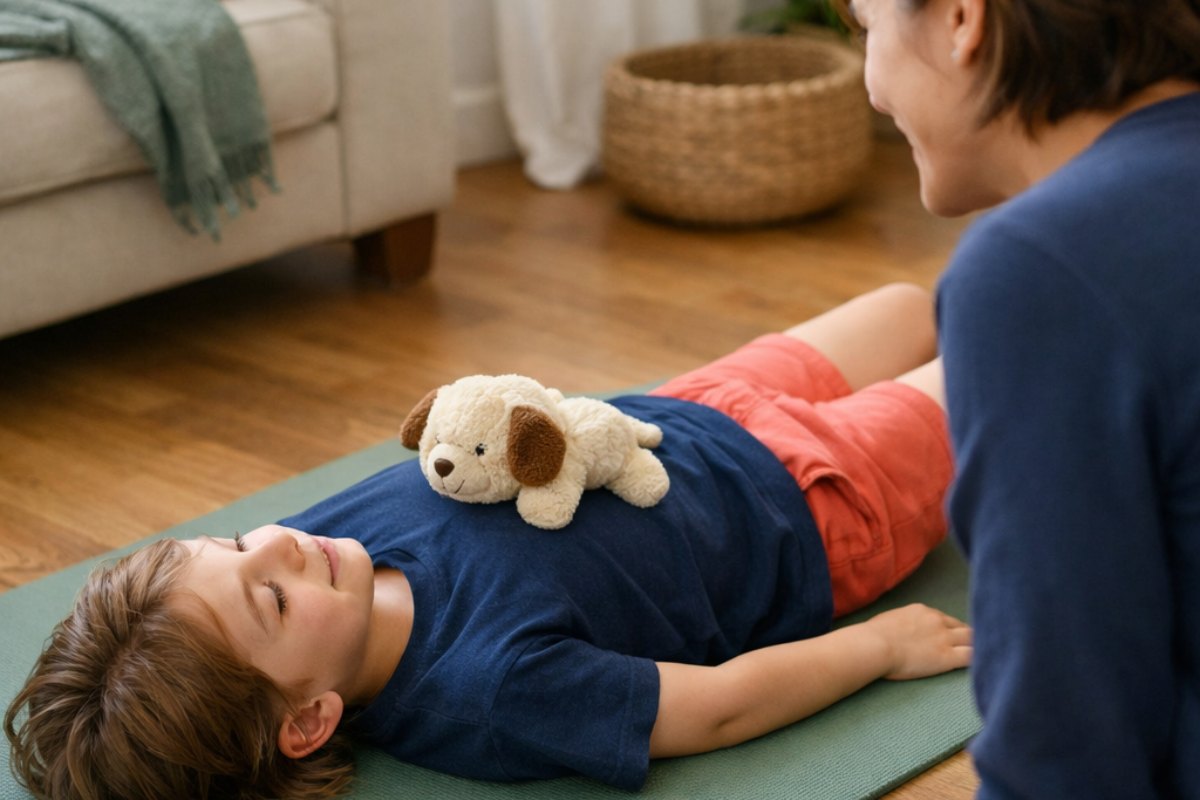
With children, it all comes down to routine: your presence helps build the habit, without turning it into a chore.
Let’s be transparent. Research on the method mainly concerns adults and urinary leakage, in small samples: the Canadian study highlighted by the method followed 30 women with no control group and was presented at a conference (Godbout et al., 2003). For children, there are practitioners’ observations and student dissertations. To our knowledge, no controlled trial has been published in an international journal; a physiotherapy dissertation already judged that its effectiveness had not been sufficiently evaluated (Devoucoux, 2016). We therefore offer it as a tool for learning to breathe, simple and non-invasive, never as a solution on its own.
Brain and body regulate together: breathing high in the chest, unevenly distributed muscle tone or a slumped posture weigh on alertness, sleep and emotions. Guylaine Bédard and Joël Lemaire, co-founders of Institut Neurosens, where Sarah Dehan trained in integrative neurotherapy, sum it up like this: “the body and the brain cannot be approached separately” (testimonial published by the Guillarme method). Elie Guillarme also spoke at the institute’s French-language ADHD Summit (Sommet francophone du TDAH) in 2025.
The method provides what is missing between sessions: daily breathing training, guided yet done independently. Sarah Dehan is listed on the map of practitioners published by the method.
The starting point: in-depth initial interview, questionnaires, quantitative EEG, and observation of posture, muscle tone and breathing pattern. How the assessment works
Breathing sensor, cardiac coherence (heart coherence breathing), muscle tension: you see the effect of your breathing in real time. Learn about biofeedback
A few minutes a day to establish the breathing technique, then to carry it over into the physical efforts of everyday life.
In parallel, neurofeedback trains the regulation of brain activity. It all forms part of our integrative neurotherapy approach, which links posture, breathing, sleep, emotions and attention. When the assessment also identifies a tongue resting too low or swallowing that needs work, FroggyMouth can complement the Guillarme method: one targets the mouth and tongue, the other the mechanics of breathing. With your consent, we liaise with the professionals who support you: doctor, ENT specialist, orthodontist, speech and language therapist, physiotherapist.
Most often around age 6 or 7. The method’s website mentions 5 to 7, depending on the child’s ability to follow instructions lying down and then sitting. Before that, blowing games such as soap bubbles lay the groundwork. We discuss it together during the assessment.
About 10 minutes a day, or 5 minutes two or three times a day, every day for as long as the difficulty persists, then at a maintenance pace.
No. Persistent mouth breathing first calls for the opinion of a doctor or an ENT specialist, who will look for a cause such as an allergy or enlarged adenoids. An orthodontist and a speech and language therapist may also be involved. The method is used alongside this care.
No, the method is practised at home, guided by the app. The initial assessment shows whether it is relevant, and we review progress together as your support continues.
The Physioflow is bought from the manufacturer, through the method’s official online shop, as a pack that includes access to the app. The useful links are included in your assessment report.