Neurofeedback guided by quantitative EEG (qEEG), targeting brain regions and networks using 19 electrodes: how it works, strengths and limitations.
The essentials in 30 seconds
19 electrodes, a 3D viewUsing the surface EEG, swLORETA estimates the activity of more than 12,000 small volumes of the brain.
A reference point: the Z-scoreEach measure is compared in real time with a normative database of people of the same age.
Networks rather than a single pointThe protocol can target regions and the connections between them, including deep structures.
Research in progressA promising approach, but not proven to work better than conventional neurofeedback.
From surface EEG to brain sources
An electroencephalogram (EEG) records the electrical activity produced by millions of neurons from the surface of the scalp. Each electrode picks up a mixture of signals coming from regions that are nearer or further away: surface EEG tells you where the measurement is taken, not precisely where the activity comes from. Imagine several microphones placed around a room: each one picks up all the voices, some more loudly than others; by comparing the recordings, you can estimate where each voice is coming from. This is the principle of electrical source imaging, which combines the high temporal precision of EEG with a calculation of how activity is distributed in three dimensions.
What is measured: 19 points on the surface of the scalp (10-20 system).What is estimated: the 3D distribution of activity, down to deep structures (illustration).
LORETA, sLORETA, swLORETA: thirty years of progress
1994: LORETA (Roberto Pascual-Marqui and colleagues) divides the cortex into around 2,400 small volumes called voxels (Pascual-Marqui et al., 1994).
2002: sLORETA, a “standardised” version, improves localisation accuracy on a grid of around 6,200 voxels (Pascual-Marqui, 2002).
2004–2006: the first 19-channel LORETA neurofeedback, followed by real-time comparison of the EEG with a normative database: “live Z-score” training.
2007: swLORETA (standardized weighted) compensates for the fact that electrodes pick up deep sources less well (Palmero-Soler et al., 2007).
2009: LORETA Z-score neurofeedback targets network “hubs”, the Brodmann areas.
2017: swLORETA Z-score neurofeedback draws on more than 12,000 voxels and includes the cerebellum and deep structures such as the thalamus (Thatcher, Lubar and Koberda, 2019).
Increasing precision: number of estimated voxels
LORETA
≈ 2 400
sLORETA
≈ 6 200
swLORETA
> 12 000
Approximate figures from the publications cited above.
These estimates remain low-resolution: they do not replace an MRI scan, and they describe how the brain functions, not a lesion. The technical guidelines published in 2025 by the IQCB (International QEEG Certification Board) also review these tools and call for caution in interpreting them (Collura et al., 2025).
The Z-score and the normative database
The Z-score expresses the difference between a measurement and the average of a reference group of the same age, in units of standard deviation, rather like a child’s height plotted on a growth chart. A Z-score of 0 corresponds to the average; about 68% of people fall between −1 and +1, and 95% between −2 and +2. As Neurofeedback Luxembourg points out, the norm and normality should not be confused: a deviation is not a problem in itself, and it is always interpreted in light of what the person is experiencing.
The Z-score places a measurement relative to the average for people of the same age: about 68% of them fall between −1 and +1.
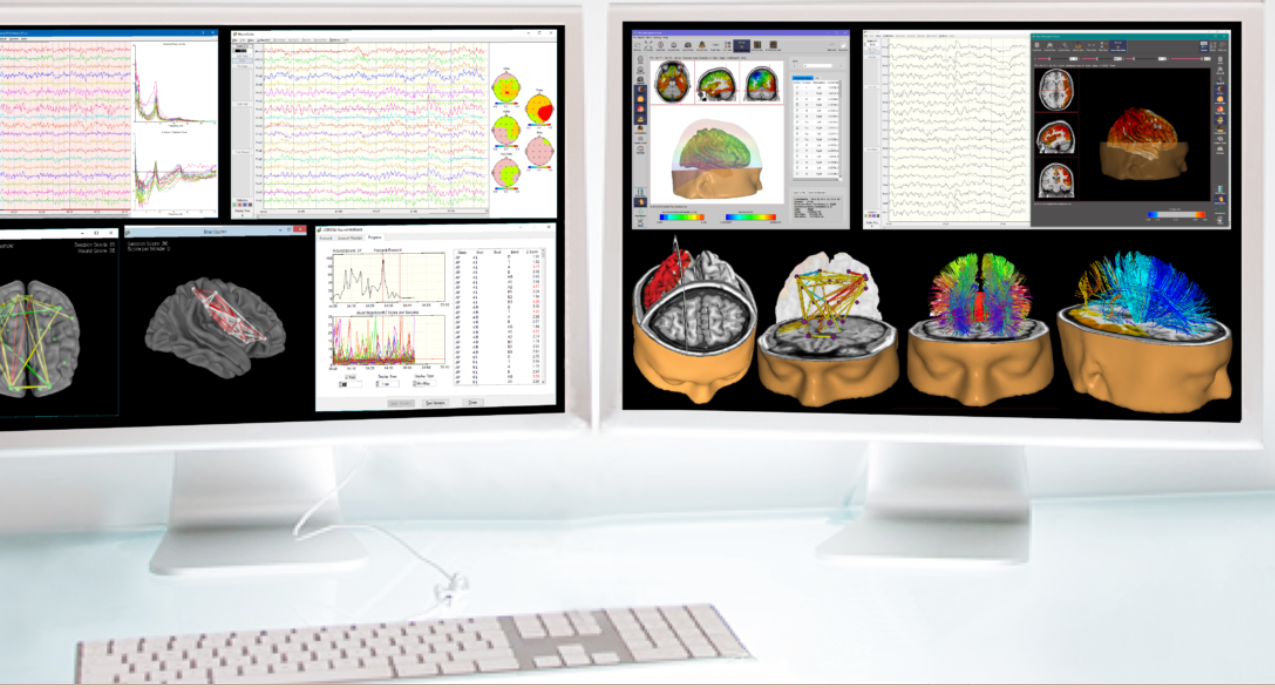
For training, the Z-score has a practical advantage: it brings very different measures (amplitude, ratios between brainwaves, coherence, phase) down to a common unit, which makes choosing thresholds less arbitrary. At the centre, the assessment and training are based on NeuroGuide software, developed by researcher Robert Thatcher’s team (Applied Neuroscience). Its normative database includes more than 600 healthy people aged 2 months to 82 years, and its LORETA version has been the subject of a validity study (Thatcher, North and Biver, 2005).
600+people aged 2 months to 82 years in the normative databaseSource: Institut Neurosens
Quantitative EEG analysis with NeuroGuide.
19 electrodes, thousands of measures
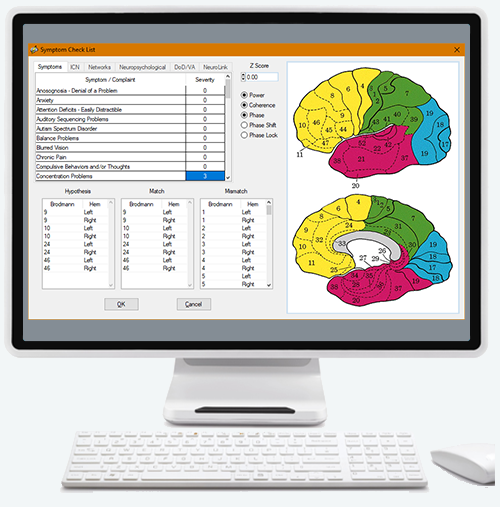
The 19-channel cap covers the whole scalp. From these 19 signals, the software estimates in real time the activity of 88 Brodmann areas (the main functional regions of the cortex) and several deep structures: thalamus, vermis, red nucleus, cerebellum. For each one, it can calculate power by frequency band, connectivity between regions (coherence), synchronisation (phase) or asymmetry. The protocol uses only a selection of these measures, chosen on the basis of the qEEG assessment, a symptom checklist and your goals.
Training brain networks
Neuroscience describes the brain as a set of brain networks: regions, sometimes far apart, that work together. Three of them have been studied particularly closely (Menon, 2011):
Default mode network
Active when the mind wanders, remembers or projects itself into the future (Raichle et al., 2001); associated with rumination when it remains too dominant.
Salience network
Detects what matters, in the environment or in the body, and helps switch from one mode to another.
Central executive network
Engaged for sustained attention, working memory and planning.
Setting up swLORETA training: targeted regions and measures.
swLORETA neurofeedback makes it possible to target measures associated with these networks (“hub” regions, links between modules) rather than a single point on the scalp. However, the link between a difficulty and a network remains a working hypothesis: it guides the protocol, but it is not a certainty.
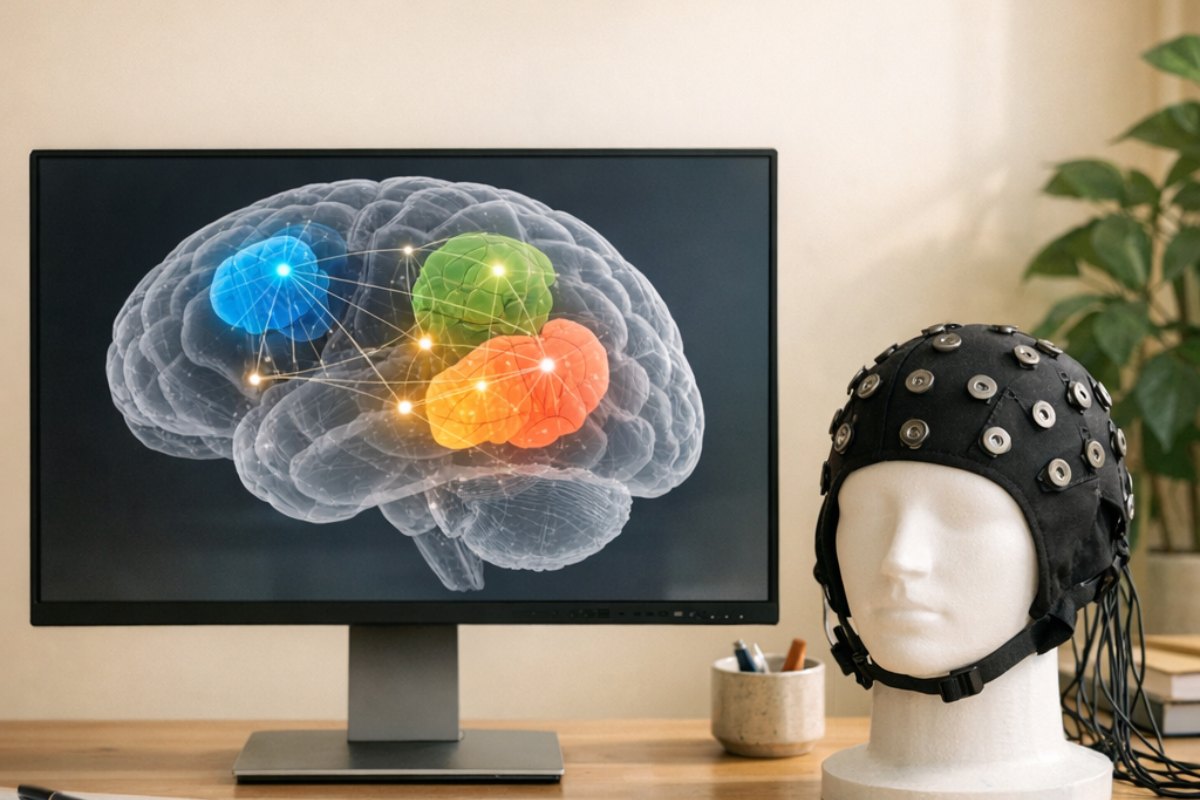
swLORETA estimates the activity of regions and networks in 3D (illustration).
swLORETA or two-channel: what’s the difference?
Criterion
swLORETA Z-score
Personalised two-channel
Sensors
19-electrode cap
Electrodes on one or two areas of the scalp
What is trained
Regions and networks estimated in 3D, several measures at once
Specific frequency bands, on one or two areas
Reference
Z-scores compared in real time with the normative database
Thresholds set based on the assessment
Software
NeuroGuide (Applied Neuroscience)
BioGraph Infiniti (Thought Technology)
Set-up
Longer (cap and gel)
Lighter, often more comfortable for young children
PreparationThe cap is fitted with a conductive gel, then the signal quality is checked.
SettingsRegions, networks and measures are chosen based on the assessment and previous sessions.
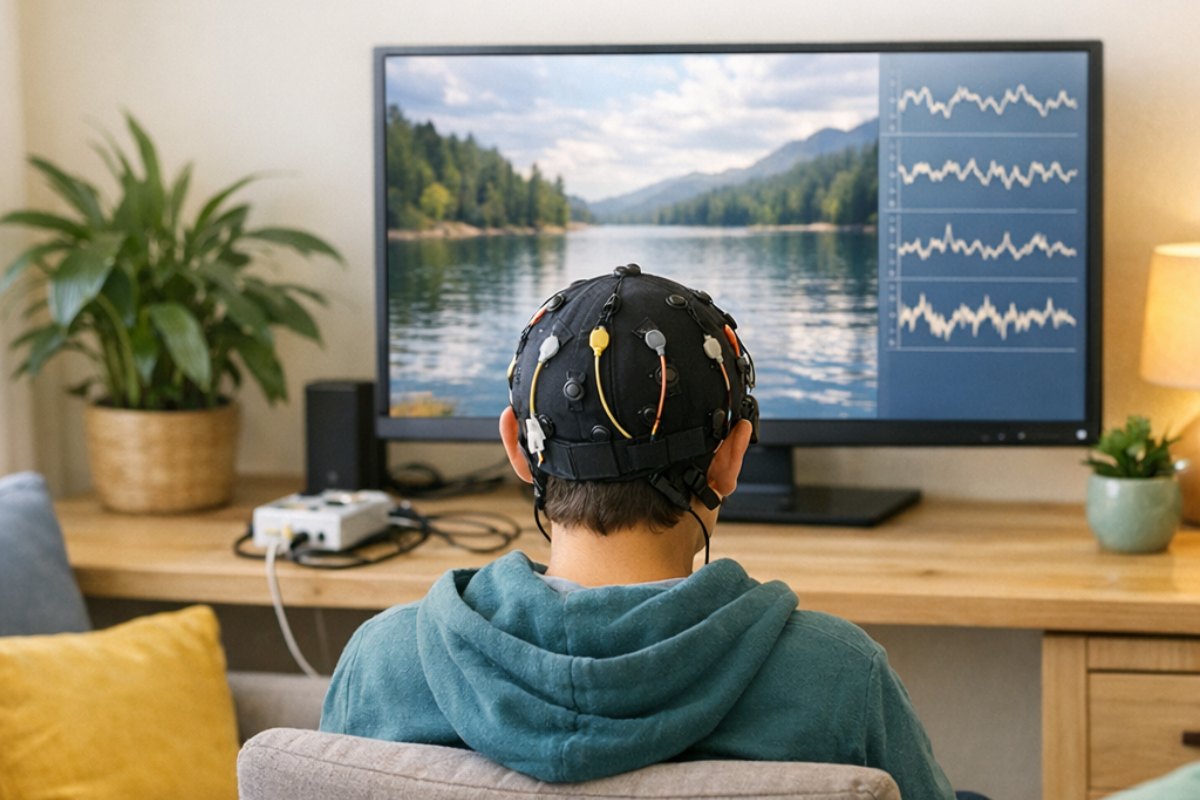
TrainingThe film stays clear when the measures move closer to the reference range, and darkens when they move away from it.
Biofeedback and discussionSome breathing or cardiac coherence work, followed by a discussion of how you felt.
A neurofeedback session: the film responds in real time to brain activity (illustration).
The idea is to stay attentive to the feedback, without trying to force things. The pace is still one or two sessions a week, and the programme includes a mid-point qEEG assessment to compare progress.
Who is it for?
swLORETA neurofeedback may be offered to adults, teenagers and children who are able to keep the cap on during the session, when the assessment shows deviations affecting several regions or their connectivity, for example in relation to attention, anxiety and stress or sleep. A two-channel protocol is sometimes more suitable or better tolerated: the decision is made at the feedback session after the assessment.
A pilot study in a clinical practice: improved attention, executive function and behaviour, with no control group (Wigton and Krigbaum, 2019)
For LORETA, better-quality studies and possible avenues in ADHD and tinnitus-related distress (Coben et al., 2019)
What is still missingcurrent limitations
Blinded randomised controlled trials
Proven superiority over conventional neurofeedback: none to date
Standardised protocols: Neurofeedback Luxembourg also notes that some practitioners overestimate its effects
A critical review, limited to published group studies, finds that these approaches still largely lack empirical validation: to date, no data show that 19-channel Z-score training is effective or superior, and the LORETA results, which are more robust, still need to be replicated (Coben, Hammond and Arns, 2019). In a small randomised trial (23 adults with chronic post-traumatic stress disorder), LORETA Z-score neurofeedback did no better than heart rate variability biofeedback, with both groups improving (Bell et al., 2019). In ADHD, a meta-analysis covering all methods found no significant effect when assessors did not know who had received which training (Westwood et al., 2025), and the French National Authority for Health (HAS) does not recommend neurofeedback for this condition (2024). Institut Neurosens sums it up as follows: the superiority of this training has not yet been established. swLORETA is therefore an individualised and promising approach whose specific value remains to be confirmed: research is ongoing, and we present it to you as such.
Complementary support. swLORETA neurofeedback does not make any diagnosis and does not replace medical care. No current treatment should be changed or stopped without your doctor’s advice.
Frequently asked questions
Is swLORETA more effective than conventional neurofeedback?
This has not been demonstrated to date. It can target more regions and networks at once, but comparative studies are lacking. We offer it when the assessment shows a profile that is suited to it.
Does swLORETA replace an MRI scan?
No. It estimates the brain’s electrical activity at low resolution: it describes how the brain functions, not its structure, and it does not make any diagnosis.
Does swLORETA neurofeedback send electrical current into the brain?
No. The electrodes only record: feedback is given solely through images and sound, and the session is painless. Just plan to wash your hair afterwards, because of the gel.
Are fewer sessions needed with swLORETA?
No robust study supports this. The typical programme is still around thirty sessions on average, reviewed at the mid-point assessment.
Can I start straight away with swLORETA sessions?
No. Training targets are chosen on the basis of the initial qEEG assessment, which is always the first step.
To provide the best experiences, we use technologies such as cookies to store and/or access device information. Consenting to these technologies will allow us to process data such as browsing behaviour or unique IDs on this site. Not consenting, or withdrawing consent, may adversely affect certain features and functions.
Functional
Always active
The technical storage or access is strictly necessary for the legitimate purpose of enabling the use of a specific service explicitly requested by the subscriber or user, or for the sole purpose of carrying out the transmission of a communication over an electronic communications network.
Preferences
The technical storage or access is necessary for the legitimate purpose of storing preferences that are not requested by the subscriber or user.
Statistics
The technical storage or access that is used exclusively for statistical purposes.The technical storage or access that is used exclusively for anonymous statistical purposes. Without a court order, voluntary compliance on the part of your internet service provider, or additional records from a third party, information stored or retrieved for this purpose alone cannot usually be used to identify you.
Marketing
The technical storage or access is required to create user profiles to send advertising, or to track the user on a website or across several websites for similar marketing purposes.