The essentials in 30 seconds
Autism: understanding a different way of functioning
Autism spectrum disorder (ASD) is a neurodevelopmental condition. It is characterised by lasting differences in communication and social interaction, together with restricted or repetitive behaviours, interests or activities. It is called a “spectrum” because every person is different: strengths, needs and the level of support required vary greatly from one person to another.
According to the HAS recommendation adopted in January 2026, the prevalence of ASD is estimated at around 1–2% of the population. Diagnosis is the responsibility of specialist teams. For young children, the French coordination and referral platforms (PCO) make this diagnostic pathway easier to access.
Communication and relationships
A distinctive way of understanding interactions, social codes and non-verbal language.
Interests and routines
Intense interests, a need for predictability, transitions that can sometimes be hard to cope with.
Sensory perception
Greater, or lesser, sensitivity to sounds, light, textures or touch.
Common associated difficulties
What makes daily life hardest is not always autism itself, but the difficulties that often come with it. The HAS also stresses the importance of looking for and diagnosing these associated conditions. A meta-analysis of 96 studies (Lai et al., 2019) estimated how often they occur in autistic people:
Anxiety, sleep disorders and attention difficulties affect learning, energy levels, family relationships and quality of life. It is these difficulties, and not autism, that we can work on, alongside other care.
Neurofeedback and autism: what the research says
Neurofeedback has been the subject of several studies in ASD, but the findings remain tentative. In a randomised trial published in 2013, 38 young autistic people received either EEG neurofeedback, skin conductance biofeedback or no intervention (waiting list). Just over half of the participants learned to modulate their brain activity, without any significant reduction in autism scores as rated by parents. The only improvement observed was in cognitive flexibility, among those who succeeded (Kouijzer et al., 2013).
A 2021 systematic review covering 20 studies and 443 children describes results that are often encouraging, but low-quality evidence, protocols that differ widely from one study to another and very few long-term follow-ups (van Hoogdalem et al., 2021).
What research suggestsavenues still to be confirmed
- Some participants learn to modulate their EEG activity.
- Possible effects on certain functions, such as cognitive flexibility.
- Possible value for associated difficulties, which still needs to be studied.
What it does not showso far
- A reduction in autistic characteristics.
- A lasting benefit demonstrated by large-scale trials.
- A validated standard protocol for ASD.
In its recommendation adopted on 8 January 2026, the HAS lists neurofeedback among the interventions that are not recommended for ASD, “because the studies have an insufficient level of evidence”. The recommended comprehensive interventions are developmental and behavioural. They should start as early as possible and be supplemented by targeted interventions (communication, independence, schooling, etc.). The HAS also warns against any method that claims to eliminate the manifestations of autism or that requires other forms of support to be stopped.
What can be worked on, alongside other care
Anxiety and emotions
Cardiac coherence and breathing biofeedback makes the physical signs of stress visible, so that you can learn to calm them.
Sleep
Evening routines, relaxation, winding down: this work takes place after a medical sleep assessment.
Attention
When ADHD is also present, training follows the same principles as those described on our Neurofeedback and ADHD page.
For children’s sleep, our article on sleep disorders in children with ADHD explains how to spot problems and the right habits to adopt, which are also useful for many autistic children.
How support works at the centre
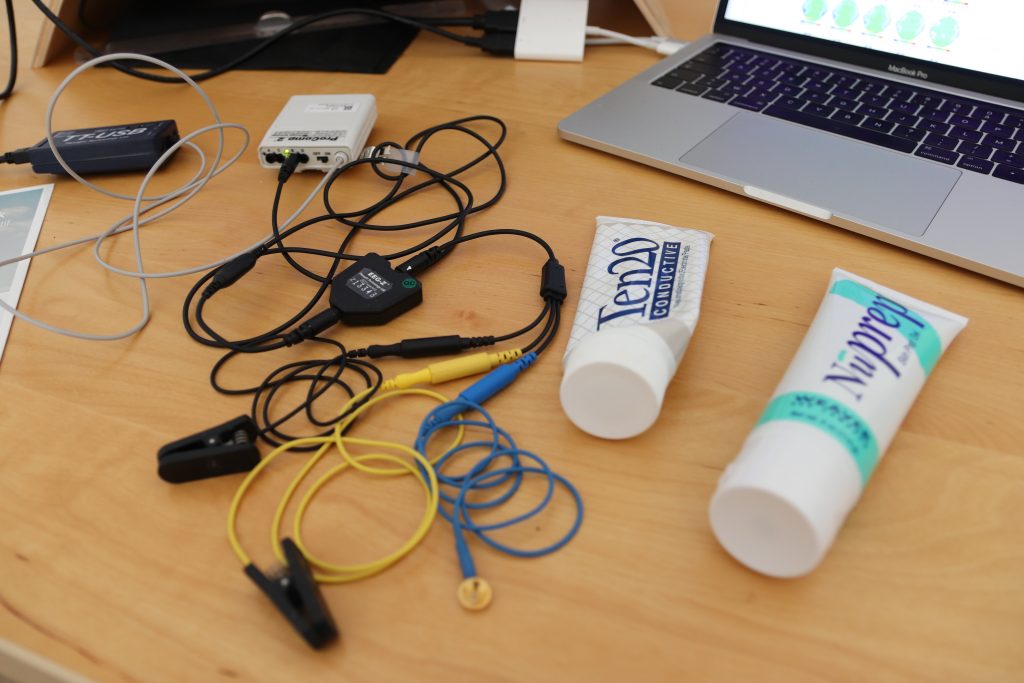
The sensors only record: they send no electrical current. We take time to show them, let the person handle them and go at a pace that respects their sensory sensitivities.
The qEEG assessment cannot diagnose autism or define “autistic profiles”: it is used solely to guide the choice of training targets. To find out more about the whole process, see the programme: from qEEG assessment to training.
Frequently asked questions
Does neurofeedback target autism itself?
No. Autism is part of who the person is and is not a target for training. The HAS does not recommend neurofeedback for ASD, owing to insufficient evidence. Support can only target associated difficulties, such as anxiety or sleep, and any decision is made on a fully informed basis.
Can the qEEG assessment confirm a diagnosis of autism?
No. An ASD diagnosis is clinical and is the responsibility of specialist teams. The qEEG assessment describes brain activity at rest and only helps to choose training targets.
My child doesn’t like being touched: are the sensors a problem?
The sensors send no current and do not hurt. We introduce them in advance, the child can handle them, and we move forward step by step, respecting their limits.
Sources
- HAS (January 2026). Trouble du spectre de l’autisme: interventions et parcours de vie du nourrisson, de l’enfant et de l’adolescent [Autism spectrum disorder: interventions and life pathways for infants, children and adolescents]. Good practice recommendation, § 3.1.3 “Interventions non recommandées” (interventions not recommended).
- Lai M.-C. et al. (2019). Prevalence of co-occurring mental health diagnoses in the autism population: a systematic review and meta-analysis. The Lancet Psychiatry, 6(10), 819-829.
- Kouijzer M.E.J. et al. (2013). Is EEG-biofeedback an effective treatment in autism spectrum disorders? A randomized controlled trial. Applied Psychophysiology and Biofeedback, 38(1), 17-28.
- van Hoogdalem L.E. et al. (2021). The effectiveness of neurofeedback therapy as an alternative treatment for autism spectrum disorders in children: a systematic review. Journal of Psychophysiology, 35(2), 102-115.