The essentials in 30 seconds
Tics and Tourette syndrome: what are they?
A tic is a brief, sudden, repeated movement or sound: blinking, grimacing, shrugging a shoulder, clearing the throat, sniffing, sometimes a word. The term Tourette syndrome (TS) is used when several motor tics and at least one vocal tic have been present for at least a year and began before the age of 18. The diagnosis is clinical: no additional tests are needed to confirm it.
According to the French national diagnosis and care protocol (PNDS) published in 2022, TS affects 0.5–1% of the population. It begins in childhood and tends to come in waves, with periods when tics get worse and calmer periods. There is good news to share with families: it improves markedly in adulthood in two thirds of cases.
TS very often comes with other difficulties, which can sometimes have a bigger impact than the tics themselves:
What neuroscience tells us
A tic is neither a whim nor a habit. Research points to the circuits linking the cortex, the basal ganglia and the thalamus, which are involved in selecting and inhibiting movements, with a role for dopamine. Genetic susceptibility and environmental factors also seem to play a part. Just before a tic, many people describe a premonitory sensation: tension, an itch, an urge that is hard to resist. The PNDS highlights three features that characterise a tic:
Tics vary with context: they often increase with stress, fatigue or excitement. Behavioural therapies teach people to interrupt precisely this “sensation, tic, relief” cycle.
Recommended care
The 2022 PNDS and the 2022 European guidelines of the ESSTS (European Society for the Study of Tourette Syndrome) agree. The first step is psychoeducation: understanding tics, informing family, friends and the school, and offering reassurance. When this is not enough, cognitive behavioural therapies are recommended as first-line treatment, in particular habit reversal and its updated version, CBIT (Comprehensive Behavioral Intervention for Tics), as well as exposure and response prevention. These therapies require regular work over several months and good awareness of premonitory sensations. The PNDS notes that their use is more limited before the age of ten. At that age, when treatment is needed, antipsychotic medication (neuroleptics) usually remains the first-line option.
Depending on the case, other options are for the doctor to decide: medication, botulinum toxin injections for certain isolated tics and, for very severe, treatment-resistant forms, deep brain stimulation. Associated conditions often need specific support.
| Who? | Role |
|---|---|
| Doctor (paediatric neurologist, specialist physician, child psychiatrist or psychiatrist) | Diagnosis, assessment of severity and of associated disorders, medication. |
| Psychologist trained in CBT | CBIT, exposure and response prevention. |
| School or employer | Information, understanding, adjustments if needed. |
| Patient association (AFSGT) | Information, mutual support, support for families. |
| Neurotherapist | Alongside other care: training self-regulation (stress, sleep, attention). |
Neurofeedback and tics: where does the research stand?
Researchers are interested in neurofeedback because tics involve brain circuits that people can, in theory, learn to modulate. However, the evidence remains thin, and neither the PNDS nor the European guidelines include it among the recommended interventions.
The 2020 trial (Sukhodolsky et al.) is encouraging, but it remains very small (two sessions per condition), uses functional MRI rather than EEG, and did not confirm the assumed mechanism. EEG neurofeedback studies are mostly case series or small trials. Neurofeedback therefore cannot be presented as an intervention for the tics themselves.
Our approach at the centre
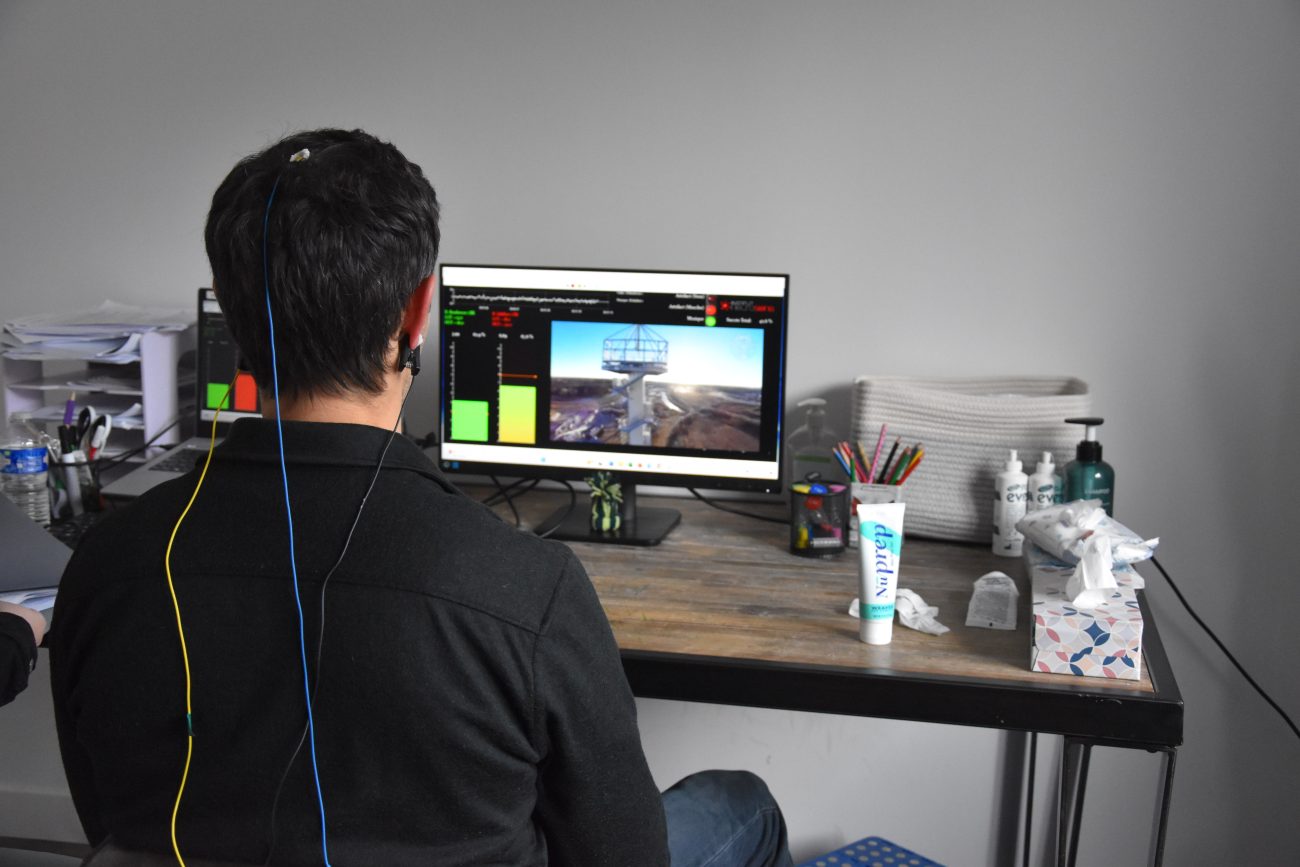
At the centre, training focuses on what often fuels tics and weighs on daily life: stress, restlessness, attention, sleep. Biofeedback (breathing, cardiac coherence, muscle tension) helps to identify and release tension; neurofeedback, guided by a qEEG assessment, works on self-regulation. This support is coordinated with the doctor and, where applicable, with the psychologist delivering CBIT.
Frequent tics often occur alongside OCD or anxiety: you can read more in our articles on OCD and anxiety disorders.
Frequently asked questions
Does neurofeedback make tics disappear?
We cannot promise that, and the research does not support such a claim. Training focuses on self-regulation: managing stress, restlessness, attention and sleep more effectively, as these often influence how intense tics are.
Can CBIT and neurofeedback be combined?
Yes. CBIT remains the recommended first-line approach; neurofeedback and biofeedback can be added alongside it, in coordination with the person’s doctor and psychologist.
Do tics interfere with the EEG recording?
Movements create disturbances in the signal, called artefacts. These are identified and removed when the assessment is analysed, and sessions are adapted: there is no need to hold back tics during the recording.
Sources
- HAS / Reference Centre for Tourette Syndrome (June 2022). Protocole national de diagnostic et de soins (PNDS): syndrome Gilles de la Tourette [National diagnosis and care protocol: Tourette syndrome].
- Andrén P. et al. (2022). European clinical guidelines for Tourette syndrome and other tic disorders, version 2.0. Part II: psychological interventions. European Child & Adolescent Psychiatry, 31(3), 403-423.
- Piacentini J. et al. (2010). Behavior therapy for children with Tourette disorder: a randomized controlled trial. JAMA, 303(19), 1929-1937.
- Wilhelm S. et al. (2012). Randomized trial of behavior therapy for adults with Tourette syndrome. Archives of General Psychiatry, 69(8), 795-803.
- Johnson K.A. et al. (2023). Tourette syndrome: clinical features, pathophysiology, and treatment. The Lancet Neurology, 22(2), 147-158.
- Sukhodolsky D.G. et al. (2020). Randomized, sham-controlled trial of real-time functional magnetic resonance imaging neurofeedback for tics in adolescents with Tourette syndrome. Biological Psychiatry, 87(12), 1063-1070.
- Nagai Y. et al. (2014). Biofeedback treatment for Tourette syndrome: a preliminary randomized controlled trial. Cognitive and Behavioral Neurology, 27(1), 17-24.
- AFSGT, Association Française du Syndrome de Gilles de la Tourette (French Tourette Syndrome Association).