The essentials in 30 seconds
What happens in the brain of a person with ADHD, and what can reasonably be expected from neurofeedback? Here is an overview of the most robust research. For a definition of the disorder and how it is diagnosed, see our article ADHD: definition, causes and support; to spot the signs in children, see our guide for parents.
ADHD through the lens of neuroscience
Networks that work together less well
The first model of ADHD focused on the circuits linking the prefrontal cortex and the basal ganglia, which are involved in controlling action. Imaging studies over the last fifteen years have broadened this view: ADHD appears to be a disorder of coordination between large-scale brain networks (Castellanos and Proal, 2012).
The executive network
It plans, holds back a reaction and keeps an instruction in mind. It is often less activated during tasks that require control.
The attention networks
They direct attention towards what matters and detect what suddenly appears. Their fine-tuning is less stable.
The default mode network
Active when the mind wanders, it should quieten down during mental effort. In many people with ADHD, it “intrudes” too easily.
So attention is not missing: it is hard to sustain and direct, especially during long or less motivating tasks.
Delayed brain maturation
A landmark imaging study followed several hundred children, with and without ADHD, using repeated MRI scans (Shaw et al., 2007). The cortex matured in the same sequence in both groups, but with a delay of about three years in children with ADHD, more pronounced in the prefrontal regions.
A very large international study (Hoogman et al., 2017, more than 3,200 participants) also found small differences in the volume of certain deep brain structures, particularly in children. These differences are real at group level, but too small to be visible on an individual’s MRI scan: imaging cannot be used to diagnose ADHD.
There is a strong genetic component: heritability exceeds 70%, according to the HAS.
EEG and the theta/beta ratio debate
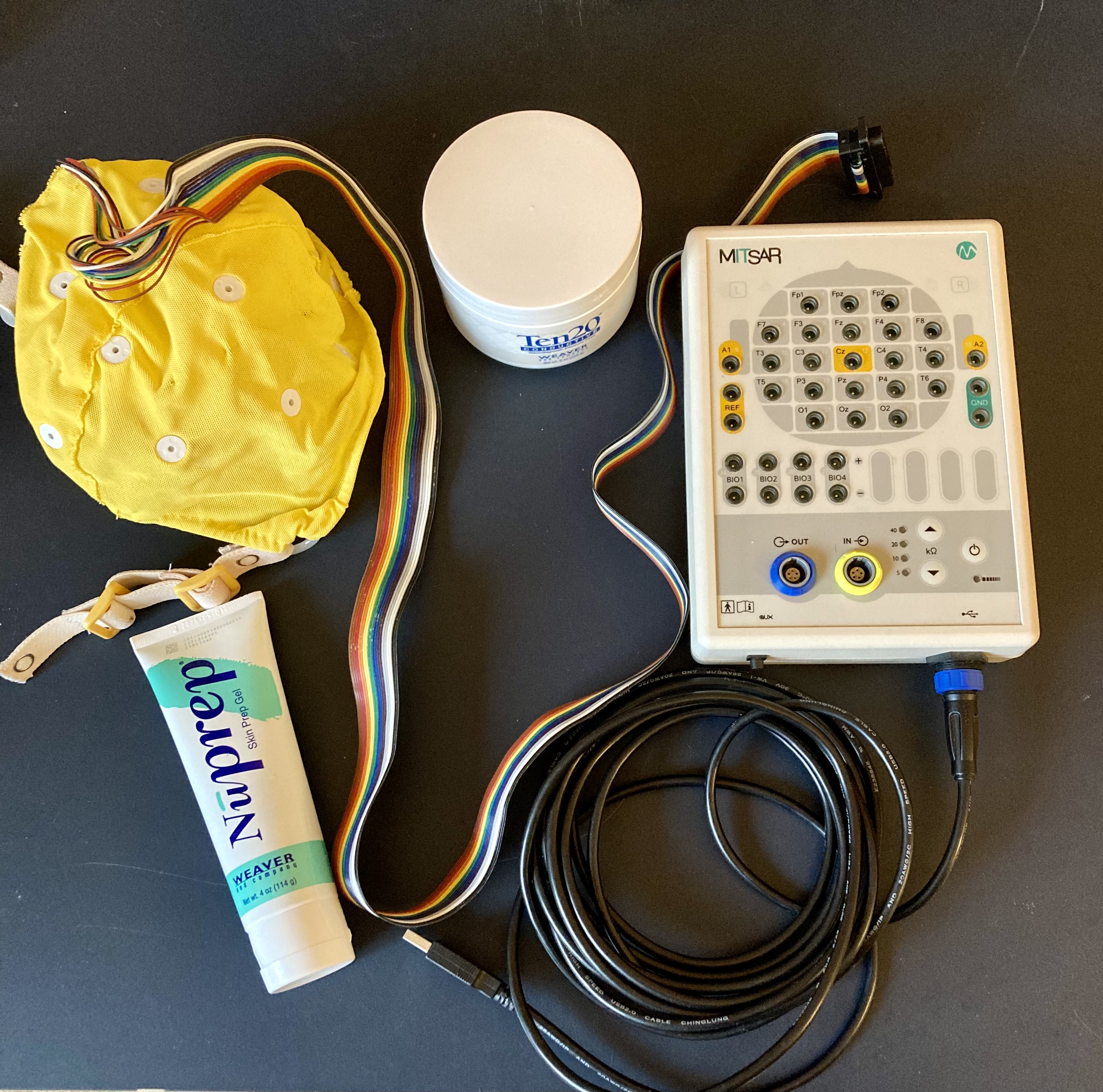
In the 1990s and 2000s, many studies reported an excess of slow theta waves relative to fast beta waves in children with ADHD, measured at the top of the head. This “theta/beta ratio” was even used as the basis for a diagnostic aid approved in the United States in 2013.
More recent data have given a more nuanced picture. A meta-analysis (Arns et al., 2013) shows that the difference between children with and without ADHD has narrowed over the years and concludes that this ratio is not a reliable diagnostic marker; it applies mainly to a subgroup of people. The American Academy of Neurology advises against using it to confirm a diagnosis (Gloss et al., 2016), and the HAS points out that no biomarker can establish or rule out ADHD.
Brain waves in a nutshell
- Delta (below 4 Hz): dominant in deep sleep.
- Theta (4–8 Hz): drowsiness, daydreaming, but also certain memory processes.
- Alpha (8–12 Hz): calm wakefulness, especially with eyes closed.
- Beta (13–30 Hz): active wakefulness, engagement in a task; in excess, tension.
No wave is “good” or “bad”: what matters is the balance between them, depending on the region and the situation.
This heterogeneity matches what we see in our own practice: EEG profiles differ from one person with ADHD to another (excess slow waves, excess fast waves, or a profile close to the norm). That is why, at the centre, the quantitative EEG (qEEG) assessment is not used for diagnosis, but to describe the individual profile and choose training targets.
Neurofeedback and ADHD: what the research shows
Neurofeedback has been studied in ADHD since the 1970s, and its results depend on how progress is measured. Parent ratings (parents know their child is training) are more favourable than “blinded” assessments, carried out by people who do not know which child received which training.
| Year | Study | What it shows |
|---|---|---|
| 2014 | Micoulaud-Franchi et al., meta-analysis (5 trials, 263 children) | Overall improvement according to parents; according to teachers, only inattention improves. |
| 2016 | Cortese et al., meta-analysis (13 trials, 520 children) | Clear effects according to non-blinded raters; not significant in probably blinded assessments. |
| 2019 | Van Doren et al., follow-up meta-analysis (10 trials) | According to parents, effects were maintained, and even increased for inattention, 2 to 12 months after the end of training. |
| 2019 | Bussalb et al., meta-analysis (French team) | Significant effect according to parents, but not according to teachers; better results with “standard” protocols. |
| 2020 | Arns et al., review of meta-analyses | Places standard protocols at the “efficacious and specific” level of its evidence scale. |
| 2021 | Neurofeedback Collaborative Group, double-blind trial (144 children) | Children improved as much with real neurofeedback as with sham neurofeedback; lower medication use at 13 months in the neurofeedback group. |
| 2025 | Westwood et al., meta-analysis (38 trials, 2,472 participants) | No overall effect in probably blinded assessments; small effect for standard protocols. |
Arguments in its favourstrengths
- Consistent progress reported by families
- Effects that seem to last after training stops
- Better results with well-defined protocols
- An active approach in which children see their own progress
Reasons for cautionopen questions
- Weak or no effects in blinded assessments
- A 2021 double-blind trial showing no difference from placebo
- The role of non-specific effects: attention received, motivation, setting
- Protocols that vary widely from one study to another
What we take from it at Centre Élan
We present these results as they are, including when they are unfavourable. Neurofeedback is not an alternative to the recommended interventions: we offer it as complementary training in self-regulation, combined with biofeedback, and we hold ourselves to three standards:
- personalised protocols based on the qEEG assessment, favouring the best-studied approaches;
- measured progress: a mid-point assessment compared with the initial assessment, questionnaires and feedback from those around the person;
- coordination with the doctor and the professionals supporting the person.
To find out how this support works in practice, see our page neurofeedback and ADHD and our article dynamical neurofeedback or qEEG: what’s the difference?
Frequently asked questions
Can ADHD be seen on an EEG or an MRI scan?
No. The differences observed in imaging or EEG exist at the level of groups of people, but they are too small and too variable to diagnose an individual. Diagnosis remains clinical, made by a doctor trained in ADHD.
Are the effects of neurofeedback lasting?
A meta-analysis (Van Doren et al., 2019) indicates that the progress reported by parents is maintained 2 to 12 months after the end of training. However, long-term blinded data remain limited: this is one of the questions research has yet to settle.
Can neurofeedback replace medication?
No. Neurofeedback can be considered alongside prescribed treatment, never instead of it. Any decision about medication rests solely with the doctor treating the child or adult.
Sources
- Haute Autorité de santé (2024). TDAH: diagnostic et interventions thérapeutiques auprès des enfants et adolescents [ADHD: diagnosis and therapeutic interventions for children and adolescents]
- Castellanos FX, Proal E (2012). Large-scale brain systems in ADHD. Trends in Cognitive Sciences
- Shaw P et al. (2007). ADHD is characterized by a delay in cortical maturation. PNAS
- Hoogman M et al. (2017). Subcortical brain volume differences in ADHD. Lancet Psychiatry
- Arns M et al. (2013). A decade of EEG theta/beta ratio research in ADHD. Journal of Attention Disorders
- Gloss D et al. (2016). The utility of EEG theta/beta power ratio in ADHD diagnosis. Neurology
- Micoulaud-Franchi JA et al. (2014). EEG neurofeedback in children with ADHD: an updated meta-analysis. Frontiers in Human Neuroscience
- Cortese S et al. (2016). Neurofeedback for ADHD: meta-analysis of randomized controlled trials. JAACAP
- Van Doren J et al. (2019). Sustained effects of neurofeedback in ADHD. European Child & Adolescent Psychiatry
- Bussalb A et al. (2019). Factors influencing the efficacy of neurofeedback in ADHD. Frontiers in Psychiatry
- Arns M et al. (2020). Neurofeedback and ADHD in children: rating the evidence. Applied Psychophysiology and Biofeedback
- Neurofeedback Collaborative Group (2021). Double-blind placebo-controlled trial of neurofeedback for ADHD. JAACAP
- Westwood SJ et al. (2025). Neurofeedback for ADHD: a systematic review and meta-analysis. JAMA Psychiatry