A small device worn for 15 minutes a day in front of a screen, to help the tongue, lips and breathing find the right automatic patterns. A partner of Centre Élan.
Some signs go unnoticed in everyday life. Taken together, they may suggest that the tongue, lips and breathing have not yet found their balance.
Your orthodontist may have mentioned atypical swallowing, or “baby swallowing” (also known as tongue thrust): when swallowing, the tongue moves forward instead of rising against the palate. Normal in very young children, this pattern can, if it persists, affect the teeth, breathing and speech. It is also seen in teenagers and adults.
FroggyMouth is a small, soft device, free from latex and phthalates, which is held between the lips. Designed by Dr Patrick Fellus, an orthodontist, at Robert-Debré Hospital in Paris, it is made in France and described by its manufacturer as a Class I medical device. It comes in three sizes. It is not an orthodontic appliance: it is not attached to the teeth.
What makes it different is passive retraining. The child has no exercises to repeat and no instructions to remember. They wear the device for 15 minutes a day while watching a programme they enjoy, and their body does the rest. Orthodontists, dentists, speech and language therapists, physiotherapists and osteopaths use it.
To swallow like a very young child, you have to close your lips and push your tongue forward. FroggyMouth keeps the lips slightly apart, so this old pattern no longer works. Saliva builds up and the child finds another way to swallow on their own, with the teeth together and the tongue against the palate: mature swallowing. Repeated every day, this movement becomes automatic. According to the manufacturer, the tongue then eventually stays high at rest, which encourages breathing through the nose.
Moving from a young child’s swallowing pattern, with the tongue forward, to mature swallowing, with the tongue against the palate.
A tongue that rests against the palate, rather than at the bottom of the mouth or between the teeth.
Lips with better tone, which stay together effortlessly at rest.
A high tongue position limits airflow through the mouth: this is the longer-term aim.
At rest, closed lips, the tongue against the palate and nasal breathing go together. A tongue that pushes against the teeth with every swallow can interfere with the balanced growth of the jaws (Quinzi et al., 2020). Mouth breathing and atypical swallowing also often go hand in hand: a 2024 meta-analysis estimates that atypical swallowing is about 3.7 times more common in people who breathe through their mouth. Its authors point out, however, that diagnostic methods vary widely from one study to another (Gómez-González et al., 2024).
Four publications on the device are indexed in PubMed: a description of the protocol (Di Vecchio et al., 2019), a series of six clinical cases (Manzini et al., 2020) and two Italian prospective studies.
These results are encouraging but should be read with caution: small samples, no control group, no randomised trial. The authors themselves call for controlled studies. More broadly, a systematic review of early orthodontic treatment and mouth-muscle training in children found the approach promising but judged the quality of the evidence questionable (Koletsi et al., 2018). No published study has yet evaluated FroggyMouth for snoring or sleep apnoea.
The manufacturer designed FroggyMouth for anyone whose tongue is poorly positioned, from the age of 3 (when chewing becomes established), with no upper age limit. At Centre Élan, we work with children from the age of 5, teenagers and adults.
| Situation | What FroggyMouth can offer | Professionals involved |
|---|---|---|
| Atypical swallowing | Making swallowing with the tongue against the palate automatic | Orthodontist, speech and language therapist |
| Mouth breathing | Encouraging a high tongue position, a precondition for nasal breathing | ENT specialist or doctor first, then retraining |
| Weak lip tone, drooling | Strengthening lip closure | Speech and language therapist, physiotherapist |
| Orthodontic brace | Supporting the orthodontist’s work and the stability of its results, according to the manufacturer | Orthodontist |
In the first few days, it is common to drool a little or pull faces: the old automatic pattern is being disrupted. The device is not painful and is not worn at night. The manufacturer’s protocol includes a check-in one to three weeks after starting, then a check at around ten weeks that the new pattern has become automatic. It is most often used for 2 to 6 months; the professional decides when the new movement has been learned.
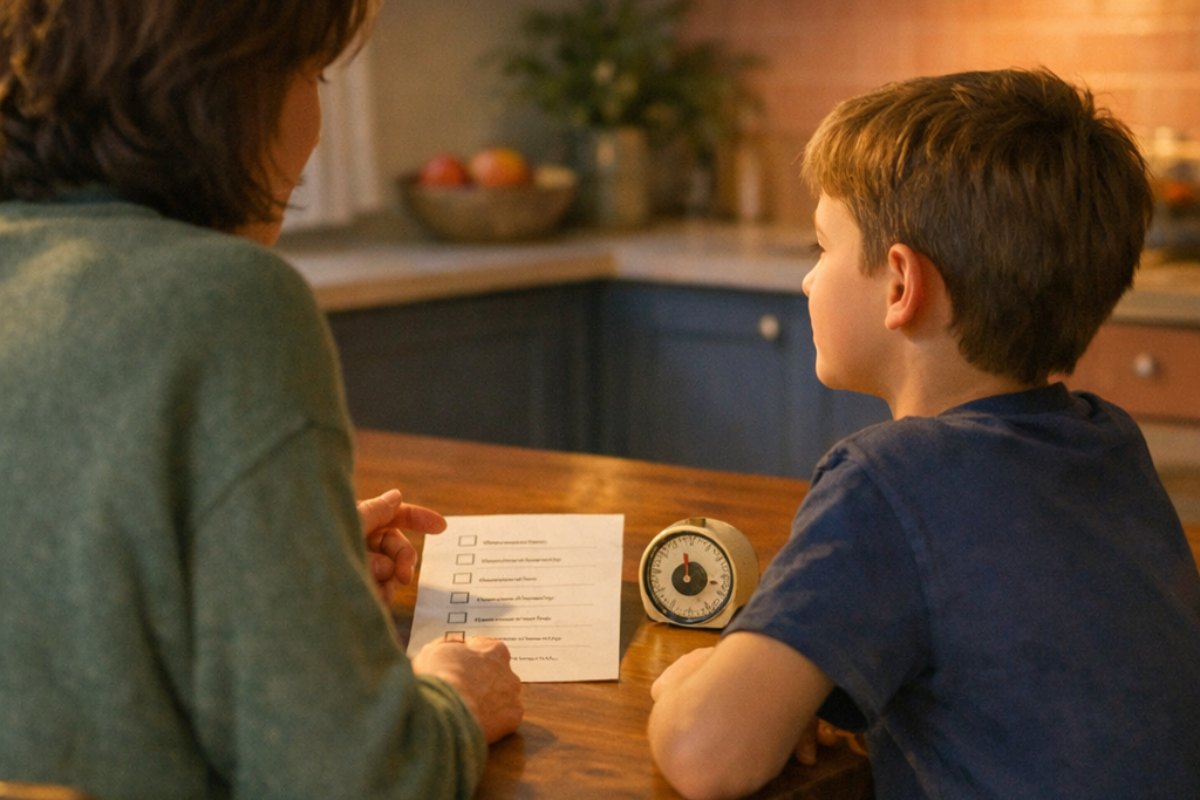
Same time every day, a timer, a programme chosen together. A longer day does not make up for skipping the next one.
The manufacturer advises against explaining the principle to the child in too much detail: they find the right movement by working it out on their own.
Keep a note of the days it is worn, and tell the professional supporting you if drooling persists.

At the centre, we work on self-regulation of the brain and body, and breathing is part of this. During the initial assessment, in addition to the in-depth initial interview and the quantitative EEG (qEEG), we observe posture, muscle tone and breathing pattern, through the nose or the mouth. Depending on each person’s needs, FroggyMouth then complements the work on oral and breathing regulation: swallowing, tongue position, lip closure.
FroggyMouth builds automatic patterns, without conscious effort. In a biofeedback session, by contrast, breathing is worked on consciously: a respiration belt shows the rhythm of the breath, and you learn to slow down to achieve cardiac coherence (heart coherence breathing). The first prepares the ground (the nose, the tongue against the palate); the second teaches you to use it to calm down. Neurofeedback works on brain activity in parallel, following the protocol drawn from the qEEG assessment.
This is the spirit of integrative neurotherapy: considering the brain, body and lifestyle habits together, because breathing, posture and sleep influence one another. Depending on needs, the Guillarme method, which focuses on breathing and posture, can complement this work.
According to the manufacturer, it can be used from the age of 3, once chewing is established, with no upper age limit. Size S suits most children under 13, and size M teenagers and adults. At the centre, we support children from the age of 5, teenagers and adults.
Yes, with most, since it is held between the lips, except those that prevent the tongue from rising (palatal expander, quad helix). Always let your orthodontist know.
A computer screen raised to eye level works. The important thing is to keep the head upright, which a book or tablet on the lap does not allow.
No, it is not painful. A little drooling in the first few days is to be expected. If it persists, let the professional supporting your child know: the manufacturer describes a short exercise to do during an appointment to help.
No published study has evaluated this yet. Snoring or pauses in breathing at night call for a medical or ENT opinion first; tongue retraining can then complement this.